
Few modern mythologies are as powerful and popular as the American West. Just evoke a handful of images (or scenes) and an entire world readily recognizable by everyone rushes to mind: the dusty street of a forgotten town, the saloon with its swinging doors, the sheriff who enforces the law with the gun at his hip, the vigilante who arrives from nowhere and disappears after settling accounts with the bad guys… On the horizon, the great prairies, horses galloping, and a handful of self-made men, ready to conquer a territory where anything seems possible. John Ford and other Hollywood directors taught us to look at the birth of a nation this way. Until one asks whether that’s exactly how we were told it or if cinema had put too much order, epic, and nobility into a story that was rather more sinister and a world not so pristine.
Demystifying the West is not a novel task
. For decades now, cinema, literature, and historiography have been dismantling the image of the fearless pioneer, the mobster, and the lone-wolf hero, reminding us that the conquest of those open spaces was also a story of dispossession, extermination, greed, and violence. The frontier did not merely separate civilization from barbarity: it was also the place where the question of who could keep the land, who imposed the rules, and who had enough influence to make their misdeeds look like respectable business decisions was decided.
The law, as so many times before, was not the same for everyone
. What is interesting is not to discover that there were baddies where they wanted us to believe there were only decent settlers and honest ranchers, but to find out how some ended up in history as criminals and others as respectable builders of a country.
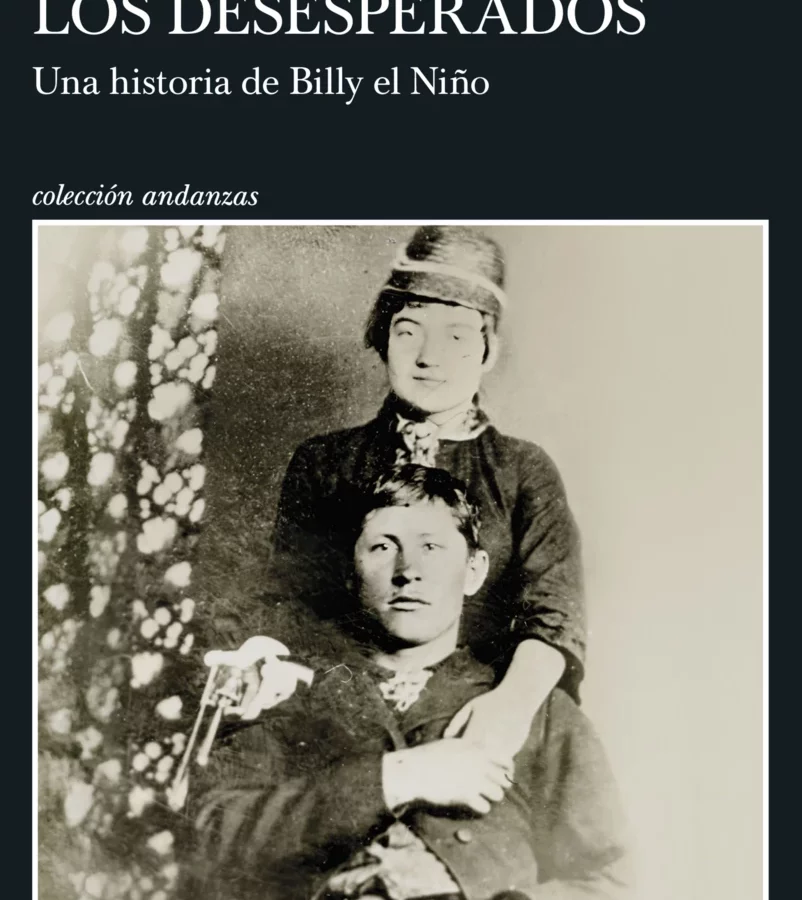
In this project lies The Desperate, by Éric Vuillard, which takes Billy the Kid as the through-line to tell a story far less picturesque than the usual Western. The renowned outlaw appears stripped of much of his legend: a poor boy, of Irish origin, with not many opportunities and immersed in a world where violence was not the exclusive property of criminals. Around Billy moves a society in which cattle rustling, the businesses of large landowners, and relations with the authorities form a web difficult to reduce to the comfortable division between good and bad. The gunslinger kills and commits crimes, naturally; but Vuillard invites us to also look at those who, without wielding a revolver, could profit far more from that violence. The uncomfortable question is who really robs whom and why some crimes end up legendary while others turn into fortune.
The approach will be familiar to Vuillard’s readers, who have made the revision of official narratives one of his hallmarks. In The Order of the Day, winner of the Goncourt in 2017, he examined the conduct of economic and political elites in the face of Hitler’s rise, exposing the machinations and pacts that history tends to leave in the background. In July 14 he returned to the French Revolution from the street, and in The War of the Poor he reconstructed the religious and social uprising of Thomas Müntzer. Across his body of work, which has also received the Ernst Bloch Prize, Vuillard shows an undeniable ability to find, behind major events, certain characters and circumstances that allow us to view them differently. His method consists of stripping solemnity from history to give it, if one may say so, a human imprint, even though that humanity often carries a rather unpleasant odor.
The Desperate is a brief book, built with episodes and connections that progressively widen the field of vision. What begins as an almost microscopic take on Billy the Kid ends up becoming a broader reflection on the violent origins of the United States, the accumulation of wealth, and the contradictions of an open society that proclaimed liberty while tolerating dispossession and exclusion. The Spanish title — the French original is Les orphelins, i.e., The Orphans — points to the losers of that American promise, focusing on those who were left out of prosperity or only found in violence a way to survive. We are not facing a conventional biography nor a customary historical novel, but a hybrid of novel and essay, a narrative supported by historical materials that it organizes and interprets with a very clear aim.
There is no doubt that Vuillard’s approach is appealing. The French novelist also possesses a keen sense for meaningful details and knows how to uncover connections and patterns that a story too reverent toward the great milestones of the past would overlook. His approach is healthy when it reminds us that economic success is not a certificate of honesty and that societies tend to be lenient with those who hold enough power to impose their version of events. He does not fall into the cliché of turning Billy into a hero of social justice. Vuillard accepts — and the reader thanks him — that there is no need to sanctify the gunman to convey the idea that the world he lived in was far from a model of justice and equity.
Now, it is also true that the French author’s approach ends up casting some suspicion. The narrator seems to have the conclusions too clear even before starting the tale. The historical materials settle into an interpretation in which the powerful accumulate wealth through violence, the dispossessed pay the price, and institutions end up legitimizing the result. That there is a great deal of truth in this view does not mean it suffices to explain the entire complexity of that society. One thing is to reveal the dark corners of the American narrative and another to turn them into the almost exclusive key to its history. Between both operations there is a distance the author does not always bother to bridge.
There is, moreover, a largely implicit moralizing stance, a bit schematic and predetermined, as in that tendency to turn social position into a moral mitigating factor for some and an aggravating one for others. To use a simple but meaningful play on words, Billy the Kid was a poor boy, but not quite a poor boy, for he was also — and above all — a violent young man, a killer, to put it bluntly. Circumstances help explain his acts, but they do not automatically render them inevitable or, far less, legitimate. Likewise, the undeniable fact that large landowners benefited from an unjust order does not permit reducing all their conduct to a single explanation. History, even when one has good reasons to be indignant about it, is usually more complicated than the theses we use to put it in order. And Vuillard’s prose, so confident, sometimes runs the risk of letting the brilliance of interpretation replace deeper analysis.
There is also a paradox: Vuillard combats the simplifications of the American legend through a narrative that also simplifies, albeit in the opposite sense. While the classic Western generously distributed medals of valor and heroism, he distributes responsibilities and blame with the severity of a strict judge who does not always leave room for shadows and contradictions. The device has literary force and moral effectiveness, but it does not necessarily yield a more complete historical explanation. One ends up missing precisely what the book aims to correct: greater elaboration and depth (or even ambiguity) in the distribution of roles.
Nevertheless, The Desperate deserves a positive appraisal, though more for its ambitions than for its results. It has the merit of forcing us to re-examine a landscape we thought we knew and to remind ourselves that official history is not so much what could have happened as the version that has managed to prevail. Rewriting it from the margins allows forgotten voices to be recovered and undeserved prestige to be dismantled. It should not consist, however, in swapping one set of heroes for another, nor in substituting a comforting legend with a counter-legend equally closed. In examining the past, while not renouncing our convictions, it is indeed wise to distrust the ease with which events can be sketched so that they always justify us. The real West was surely less noble than John Ford’s, but also quite a bit more complex than Vuillard’s. And perhaps there, in that discomfort of not being able to draw explanations with straight lines and neatly assign responsibilities, lies the dirty reality and the true start of history.
—————————————
Author: Éric Vuillard. Title: The Desperate: A Story of Billy the Kid. Translation: Juan Manuel Salmerón Arjona. Publisher: Tusquets. Sales: Todos tus libros.