
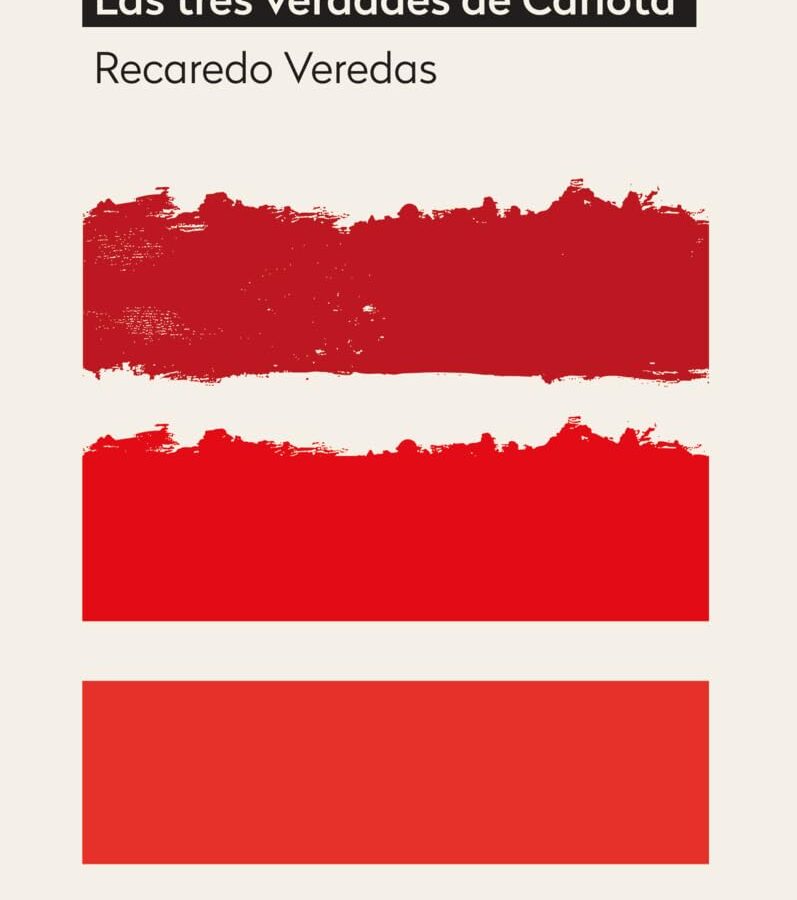
The story of The Three Truths of Carlota, by Recaredo Veredas (Madrid, 1970), is so simple, and perhaps so cliché at the same time, that it will surely sound familiar. A pampered woman grows tired after nine years with him, a boyfriend with whom she lived and slept in the United States. She returns to Spain, where she reconnects with some old classmates from her Master’s in Publishing who have just founded and launched a literary publishing house named Las Manos Tendidas. They welcome Carlota as the pampered person she is, and although the publishing house was thriving, it was selling something and functioning; who could be capable of rejecting the capital that Carlota, a benevolent socialite, was willing to invest in them, in a newly created publishing house that began to prosper in reality and that from now on would aim to do so on Instagram? No one.
Las Manos Tendidas passed from being merely a publishing house name to embody the stance of two novice editors, Tirso and Alicia, who would not be willing to risk themselves or jeopardize their future careers. And that, even though they had left their previous jobs “with arrogance, not looking back,” yearning for the creation of a publishing catalog as if it were manna, in addition to the most genuine “attempt to go to the bottom of the human condition.” I insist, I repeat the question I raised in the previous paragraph:
Who would reject someone who arrived with outstretched hands and who belonged to a family, the Vergaras, possessing a considerable fortune?
Not even the Trojans did.
The novel by Veredas has a tripartite structure. Each chapter, in turn, is subdivided into three parts of unequal length. This form might be seen as an attempt to play with the book’s own title, The Three Truths, but since it concerns the story of its three protagonists, who strive to assemble a publishing catalog — why else would you start a publishing house? — Veredas gradually inserts small clues that reveal the story, or the nature of it, which will revolve around “the darkest angles of the human being.” And while that is the aim of the collection they aspire to create, it is true that behind the editing of any book in fiction and here in reality “the same phrases can heal someone who lives on a fifth floor without an elevator in Vallecas or in a Paris mansion. They show that their pain exists, that someone has written about their sorrow or secret.”
Perhaps The Three Truths of Carlota is about human pain and whether one solution to combating it lies in the publishing of good literary works. Or not. And what Veredas truly demonstrates in the novel is the different morals held by those who succeed and who are capable of overriding the judgments of the people around them. This book also exposes those who treat others as if they were fools, a truth that surfaces repeatedly in the stream of consciousness of two of the protagonists, Alicia and Carlota: “They treat me as if I were an idiot. My family because I don’t dedicate myself to serious things. Outsiders because they think I have everything. And what do I have? Thirty-seven years old, a impotent boyfriend —another one, not the American—, a mother who asks when I will give her grandchildren and a brother who treats me as if I were subnormal. Is that what it means to have it all?” The consequence will not materialize, but it sounds like an ultimatum: “I’m thinking of leaving it […] with those gents.”
But the “first milk is never vomited,” and she, Carlota, will become the bond that tightens around the necks of Tirso and Alicia. No one doubts this reality and truth that fiction offers: the publishing business “is for millionaires, for people who can throw money away in exchange for a bit of prestige.”
The prominence Carlota gains over the course of the novel reaches saturation around the middle, but is quickly resolved, at first, by the news of death of her most successful writer, who commits suicide. From that moment, Juana becomes a kind of anima who not only sustains Carlota, the benevolent patron, but also Alicia, one of the editors, and it is Juana who affirms a publishing truth that should be carved on the door of these companies: “We cannot live only by selling four books to four hipsters who think they are special.” Simple, yet resounding.
The last third of the novel unfolds convulsively. After a fierce dispute between Carlota and Alicia over Juana’s death—the suicidal writer—Veredas seems eager to end and close the narrative. And he rushes, from my reader’s perspective, because although the action from that moment onward—there remains a third to its end—unfolds naturally to a point, it is not the internal mechanisms of the plot, the characters, or the events that build the intrigue or move it forward. Perhaps there is an overacting by the author through his narrator, who grows in omniscience to provoke, in a somewhat childish manner, the disappearance of two of the story’s core elements, making the reader murmur sotto voce: “But he has taken away something fundamental!” In fact, from that moment on, the argument polarizes, concentrates, and becomes almost suffocatingly focused on the character of Carlota.
The three truths are spoken, indeed. And unveiled. Nevertheless, Recaredo Veredas’s narrative fairly faithfully reflects the submission suffered by many small publishing houses that must survive and breathe capital that, in most cases, comes from people not especially aligned with editorial excellence.
There are secondary lines, sacred wells that reveal themselves as scourges within the publishing industry and which, in a broad sense, Veredas has known how to expose, among other reasons because he knows the sector and the machinery of making good and bad books and surviving thanks to them: who hasn’t used author presentations, any event, as a pretext to head home to dinner?
This work, I have come to think, reveals a nemesis, a punishment that happens for the error committed at the beginning by its protagonists, among other reasons, because they dare to cease to be faithful to an ideal that pursued editorial excellence.
—————————————
Author: Recaredo Veredas. Title: The Three Truths of Carlota. Publisher: Sr. Scott. Available at: Todos tus libros.