
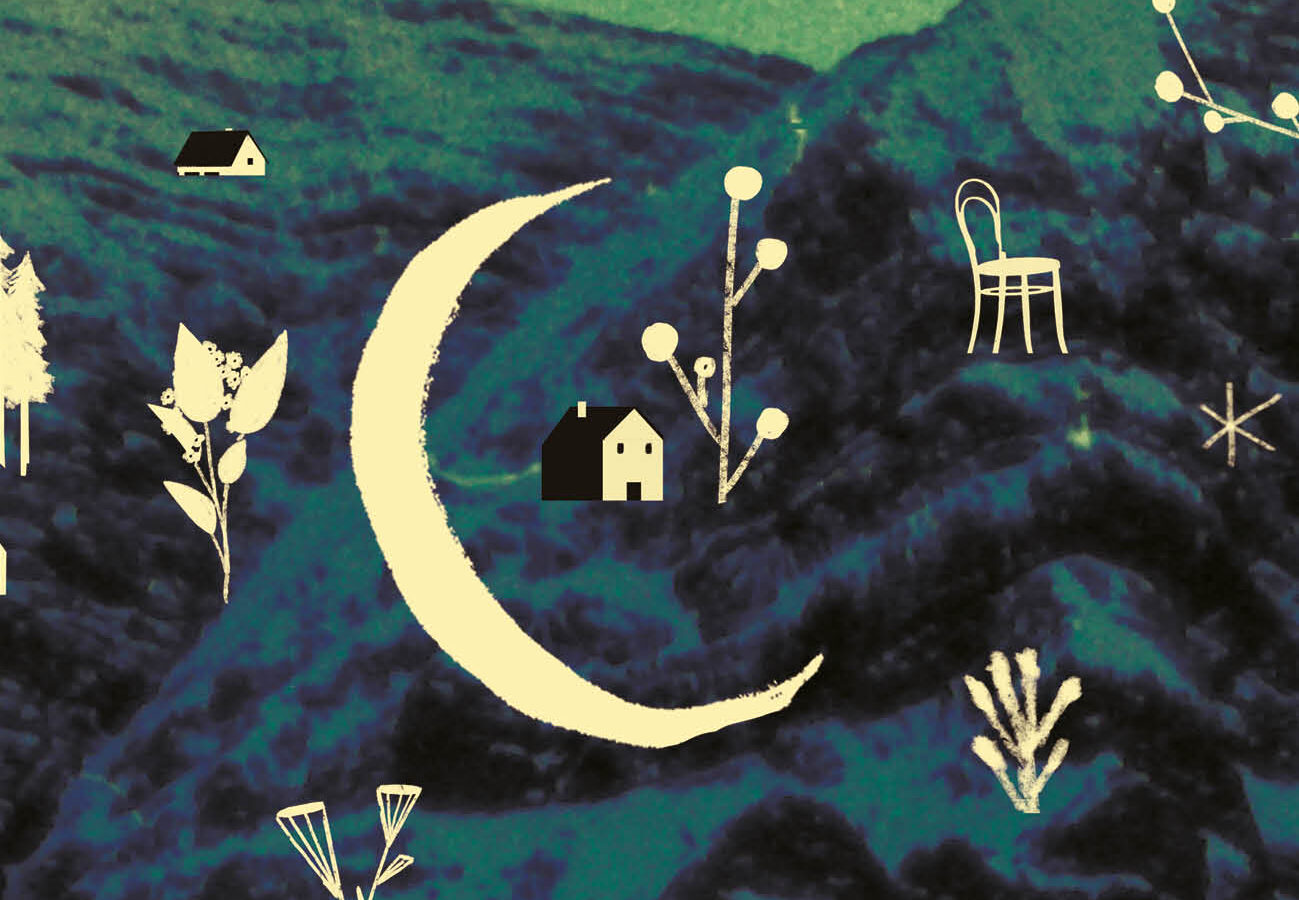
To discuss the mountains, it is useful to call on a coral world. In that natural realm, in those places where John Muir claimed that there is no pain once you reach the summit, there are millions of forms of life. Not all those lives reside at the very top, at the peaks that, in many cases, can be reached by several routes. In other places, only risky paths fit. Frequently, mountain literature focuses on these latter aspects—on alpine adventure, on the challenges and on survival. But in the mountain there is much more life, including that of those who await the climber or those who watch them. A place like the Pyrenees, which serves as the reference for this work with a title so meaningful, No subir montañas, has always been inhabited by another kind of people: there is a rural world and there is a natural world. The valley lilies are mountains, as are the shepherds.
To bear witness to this, Paula Pontes (Sesué, 2000) conceived an epistolary work in which the cross-writing among several people forms a puzzle, but a puzzle that reaches us with the pieces laid out to be fitted. We should say that the letters carry a heading, they confess to whom they are addressed, but they bear no signatures. One can form an idea of who authored each of them by tracing the clues left by those who will read them, but this is not the game the book proposes. In reality, it is a form of reunion, one that occurs when sharing a common memory. In fact, all these narrators, all these recipients, when they express themselves use the same voice, the same resources, the same simplicity. The aim of not differentiating the voices is to construct a single, which will be plural, but it is the result of the intention to express a single message, the one that links memory and life.
The memory of all those involved is shared. They are going to tell us about times that perhaps were better, the analogue era, the time when it was easier to focus on the immediate activity and on the immediate surroundings. It is likely that that good world will never return, that the good world has been left behind, but that does not prevent us from continuing to enjoy it, reliving it, as the character collects old slides in this work to share them with others. In that revisitation, the mythification of the summits appears, yes, because it is inevitable to speak of beauty, but there is also the effort, both that of the climber who is part of the group and that of the women who kept the stables clean. And there appear the absences, not only of landscapes, but also of those who are not there, even if we do not know the reason why they are referred to as part of a common past. The sense one has, and which is rarely clarified, is that this group of people shares a family. Perhaps it is not an organic family, but as a family they understand each other. Indeed, that is how they participate in the spirit of a moment in time that adds value to the images of the past. We are facing a coral work, but the chorus is that of a single soul. And that soul is aware of the multiple ways there are to live the mountain. There is the climber, and there is the one inclined toward Taoism, whose spirit is also found among the peaks and valleys, and there is the survivor and there are the people, the ordinary folks, those who were born there and there toiled to sustain a life in which there is a survival that does not renounce the nourishment so indispensable for living, which is beauty.
—————————————
Author: Paula Pontes. Title: No subir montañas. Publisher: La Caja Books. Sales: All your books.