
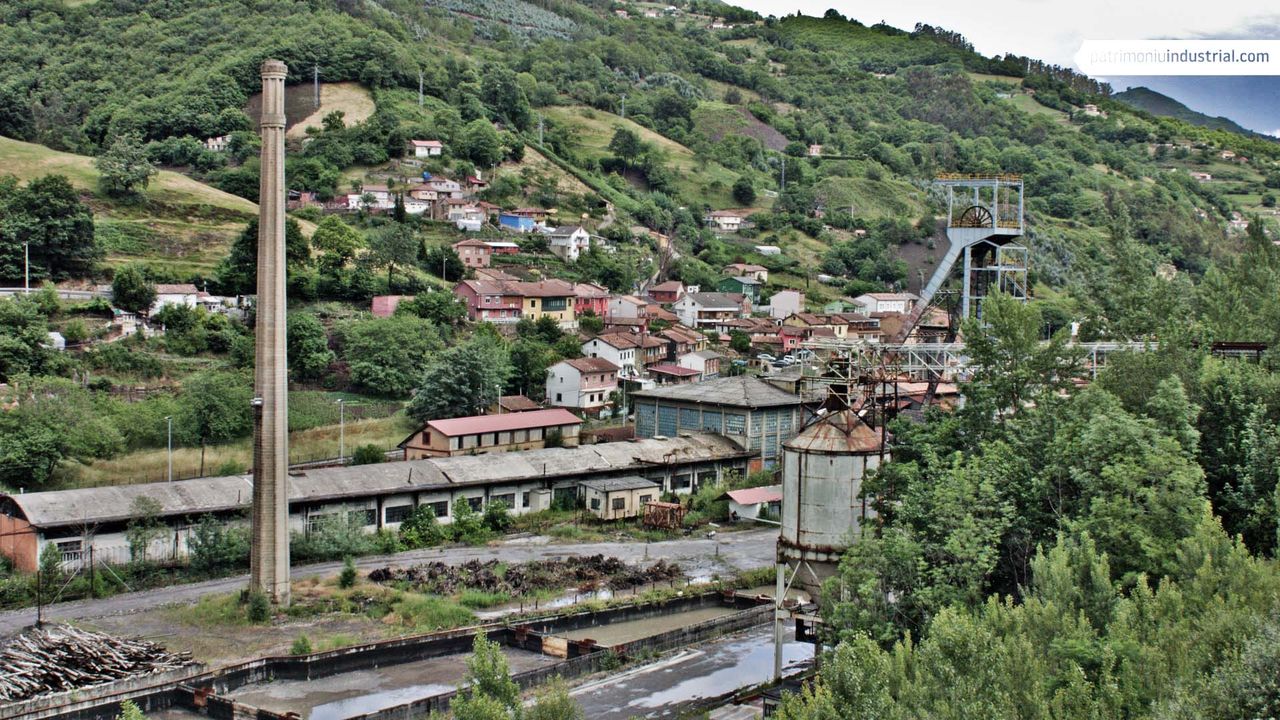
There are things you tolerate more or less, and others that, once a certain limit is crossed, become hard to stomach. I can, for example, accept that someone confuses Mieres with Langreo, ascribes to the Caudal region a trait that belongs to the Nalón area, or fails to distinguish the port of Payares from the Huerna valley. These are, after all, understandable mistakes for those who have not been lucky enough to grow up from childhood with the geography of Asturias’ coal basins imprinted in their minds. What has become intolerable to me in recent times —though I also understand why— is that many people, upon hearing the word Figaredo, immediately think of a certain far-right deputy; and even more so that, when they discover there is a town of that name, they automatically assume that the little deputy in question is from there. And no, I am very sorry; up to a point we could tolerate it, because one thing is that we from those lands had to reinvent ourselves, and another that we should also be made to bear misfortunes that are not ours.
“Not content with extracting coal from the bowels of the earth, those men decided to make the toponym their own.”
So it is worth starting by clarifying that the ineffable José María Figaredo is not a native of Figaredo, but was born in Gijón. It happens that at a certain moment, in the early days of the previous century, his family decided to appropriate the name of the village where their wealth was being forged. It is worth explaining this because perhaps the move stands as one of the most refined manifestations of extractive capitalism; not content with drawing coal from beneath the earth, those men also resolved to seize the town’s name as their own. The history begins in 1866, when Vicente Fernández Blanco obtained the Paz Coto concession, located in a small place called Figaredo about four kilometers from the town of Mieres del Camino. Some time later, his son Inocencio Fernández de la Vega expanded the business to become one of Asturias’ principal coal mines. The Fernández family prospered at cruising speed, extended their interests into other economic sectors, and, at some point, must have concluded that the surname they bore sounded too vulgar for the status they aimed to project. There were too many Fernández around, that much was clear, and not everyone could afford to own a mine. The rank, they thought, had to be more conspicuous. So in 1915, and I imagine without asking anyone or organizing a referendum to see what the neighbors thought, they adopted the town’s name as their surname.
“Ultimately, it was the State that had to take charge of the operation, assuming its debts to guarantee its continuity and the jobs.”
The family businesses grew. Vicente Figaredo (yes, that one) Herrero acquired other mining properties and participated in the creation of institutions such as the Banco de Oviedo and the Banco Gijonés de Crédito. Wealth seemed to sprout spontaneously from the mountains, but you and I, and any decent person, know that the miracle required the participation of hundreds of men who descended every morning into the depths to do the dirty work and returned at dusk with lungs battered and bodies worn down. And in this regard, the relations between the family and its workers were not exactly idyllic. There were many disagreements, but the most significant episode occurred in 1978, when Minas de Figaredo announced a payments default that threatened to leave about 1,650 workers without work. The miners, who by then had already endured several months without pay, organized a mobilization that stretched for seventeen months, during which there were lockouts, demonstrations, and roadblocks, but also a solidarity that exceeded the comarca’s borders. One of the most memorable moments of that time was when several workers held José María Figaredo Sela, then co-owner of the pit and grandfather of the immigrant-hunting deputy, aloft for hours at the top of a headframe. In the end the State had to assume the exploitation, taking on its debts to guarantee its continuity and the jobs, because some great fortunes like to invoke the freedom of private initiative when it comes to filling their pockets, but do not hesitate to resort to public funds if the accounts stop balancing and debts have to be faced.
“That is why I believe the moment has come for the restoration of Figaredo’s good name.”
Thus the deputy, who often tramples reason from the tribune of the Congress, has behind him a history that, as you see, is far more interesting than his unfortunate parliamentary interventions. He is also related to Rodrigo Rato, which suggests that family gatherings in that house could yield several Balzac novels. Let me be clear: I do not intend to hold him responsible for the actions of his ancestors or his relatives—each must answer for their own deeds, and that man has enough of his own. What worries me is that toponymic injustice that links the name of a working town to the musings of a politician who seems to have found in defending privileges his true hereditary vocation. Because the Figaredo of real substance, the people, is something else. Figaredo are the houses built around the mines, the roads that led to the shafts, the women who kept life going while the men mined coal in the depths; they are the families that learned to live with fear, the generations that gradually secured rights while accumulating, indeed, sacrifices. Figaredo’s story is one of effort and dignity that cannot be contained in a family tree, written by those who never appear in notarial records, yet who make it possible for others to sign them.
That is why I believe the moment has come for the restoration of Figaredo’s good name. I am not asking the deputy to recover his former and not unblemished family surname of Fernández, though that would not be a bad solution either, nor do I intend to file any complaint. I would be satisfied with setting the record straight and establishing a definitive distinction between the surname he bears and the place from which it was taken, between those who made millions from the mines and those who spent a large part of their lives there. After all, Figaredo existed before the Fernándezes arrived, and it will continue to exist long after the deputy is forgotten. Lineages die out, fortunes change hands, and politicians come and go. Towns endure, even if they sometimes have to defend themselves against those who claim to speak for them, and if there is one thing we who come from the mining basins know, it is that there are things that cannot be bought, not even when one wields enough power to usurp a name.