
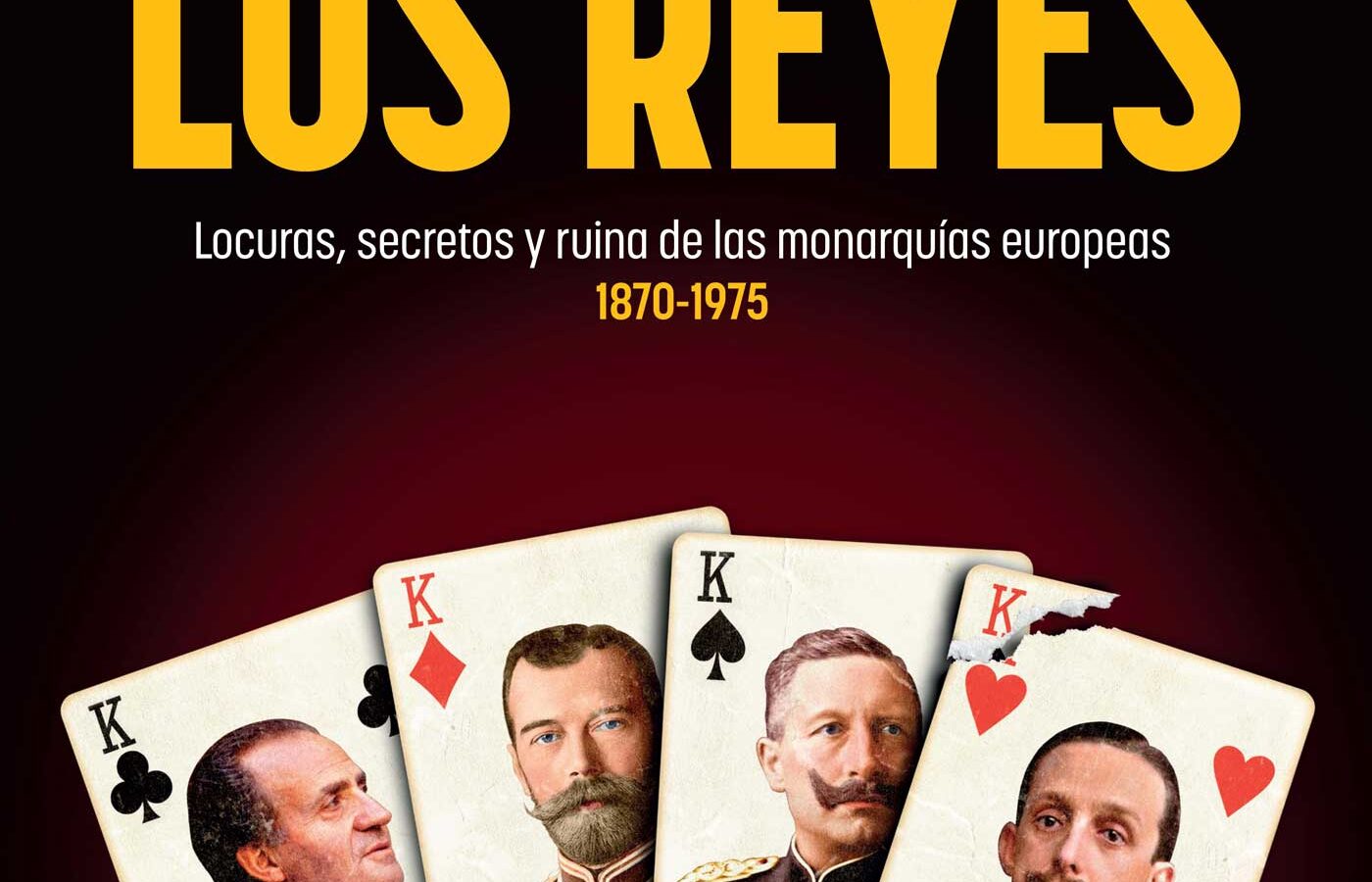
This book tells, in a historical and humorous vein, the extravagant end of the great houses in the period spanning the interwar years.
In this making-of, the author explains how he wrote The Twilight of the Kings (La Esfera).
*****
If, at the end of the nineteenth century, republics were a rare anomaly in Europe, after a few decades the exceptional became the monarchies. Alfonso XIII of Spain was one of the first to realize that he had been left alone, turned into a dated extravagance. What happened in between had many riders of the apocalypse: revolutions, civil wars, invasions, scandals, corruption… As in a television series, the problems did not stop growing for kings who, in the end, were responsible for their downfall. The monarchs could learn the lesson and adapt to the new constitutional and liberal times, but the vast majority did not even try. Indeed, changing has never been the strong point of those who lived too absorbed in frivolities, obsessions and craziness that could not be more alien to their diligent subjects. Only a handful of these prehistoric creatures would have to survive the republican meteor.
I have written The Twilight of the Kings, within my collection of books about crazy kings, to try to shed some light on the mystery of how, in the early decades of the twentieth century, those grandiose European royal houses could so quickly move from apotheosis to twilight. Part of the answer to this pronounced fall lies in the fact that crisis situations bring out both the best and the worst in us. The most mediocre kings were inevitably portrayed, while the brightest and noblest on many occasions had to choose between surviving at the cost of a civil war or leaving to avoid bloodshed. In the first group would be flamboyant figures such as the Kaiser Wilhelm II, whose hyperactive and hypernervous personality has fascinated me while writing the book, or the Tsar Nicholas II, who vacillated throughout his long and turbulent reign. And in the second group there would be monarchs like the last Austro-Hungarian emperor, Charles of Habsburg, who in his overflowing humanity chose not to remain on the throne, relying on the loyal army still at his disposal.
But, undoubtedly, it was the exceptional circumstances and not the protagonists themselves that marked the real collapse. After World War I, which ended four great empires and dozens of royal houses, came the rise of radical ideologies openly hostile to monarchy and, above all, the threat of a history-annihilator named Adolf Hitler, who flirted with the German monarchists merely to obtain more and more power. Once at the head of everything, the Austrian painter revealed himself as one of the greatest enemies of the European kings, starting with the Habsburgs and continuing with all the dynasties, including the British and Dutch monarchs, who decided to resist his advance across the old continent. Hitler did not live long enough to be crowned or celebrate his victory over the sovereigns, but neither did they return to their thrones under the same conditions. If they could return…
That the monarchy remains an institution in retreat and far from rebirth is not an opinion, it is a fact. By 1900 there were roughly one hundred and fifty monarchies around the world, while today forty-two countries survive with a crowned head of state, of which more than a dozen share the British monarch in a completely symbolic fashion. Only ten of these monarchies belong to Europe, not counting the singular cases of Andorra and the Vatican. They are the historic monarchies of Spain, United Kingdom, Denmark, Belgium, Norway, Sweden, the Netherlands, Luxembourg, Monaco and Liechtenstein. Although in some of these countries the king as head of state retains prerogatives similar to those of monarchs fallen for overstepping, many today guard their political neutrality and their role is more ornamental than — to use the redundancy — real. Perhaps for that reason none of these houses is questioned enough to think there will be fewer monarchies on the Old Continent in the near term. On the contrary, they enjoy very high approval ratings and have managed to avoid the generalized deterioration of democratic institutions.
And that is the great contradiction of our times. Nobody wants the monarchy anymore, but those who hold it do not want to part with it. They need it to keep the barbarians at the gates. According to The Economist’s annual ranking to measure democratic quality worldwide, eleven monarchies are among the twenty-two leading countries. This is explained, above all, by the fact that in a fluid era and a value-driven decline, monarchies represent the immutable, immune to fashions and resistant to volatile discourses. People want guarantees where there is only uncertainty. European kings have become steadfast guardians of democratic systems against populists who promise strong emotions. They do so without dirtying their hands or spending their prestige. Those who ask, for example in Spain, that the monarch take a more partisan stand against parliamentary initiatives that could threaten the Constitution do not understand the same essence that keeps them alive one more day: discretion. They do not understand their more recent history.
Monarchies that survived the two world wars and their dangerous aftershocks did so through a blend of prudence, earned prestige and luck. The first was not to fall on the communist side of the Iron Curtain, and the second was to conduct themselves with dignity in the face of poisoned offers made by fascists and Nazis, or at least to rid themselves of them in time. The kings of Belgium, Sweden and Monaco resolved suspicions of having leaned too closely to Hitler with swift, though not easy, changes of reign. The King of Italy followed the same strategy by ceding the throne to his son, but for the Savoys it was no longer possible to detach themselves from such a syrupy relationship. For those who survived the republican tsunami, the postwar opened a wide range of opportunities and moments of prominence wherever the old world was a pleasant memory, prior to the era of hate and polarization. How they behaved in the wars fed national myths. Their romances with commoners filled the tabloids with crowns. And their archaic rituals thrilled the Steven Spielbergs that lives inside us all.
The enemy since then of these reigning houses, of course, has been to ride out their inherent magnetism amid scandals, some as persistent as those of King Carl XVI Gustaf of Sweden, whose parties with prostitutes were messier than a jelly pool, or those of Prince Andrew of the United Kingdom, who appears with neon lights in the Epstein papers. It is worth remembering that Juan Carlos‘s are not the most dreadful stains on the tablecloth.
—————————————
Author: César Cervera. Title: The Twilight of the Kings. Publisher: La esfera. Sale: Todostuslibros.