
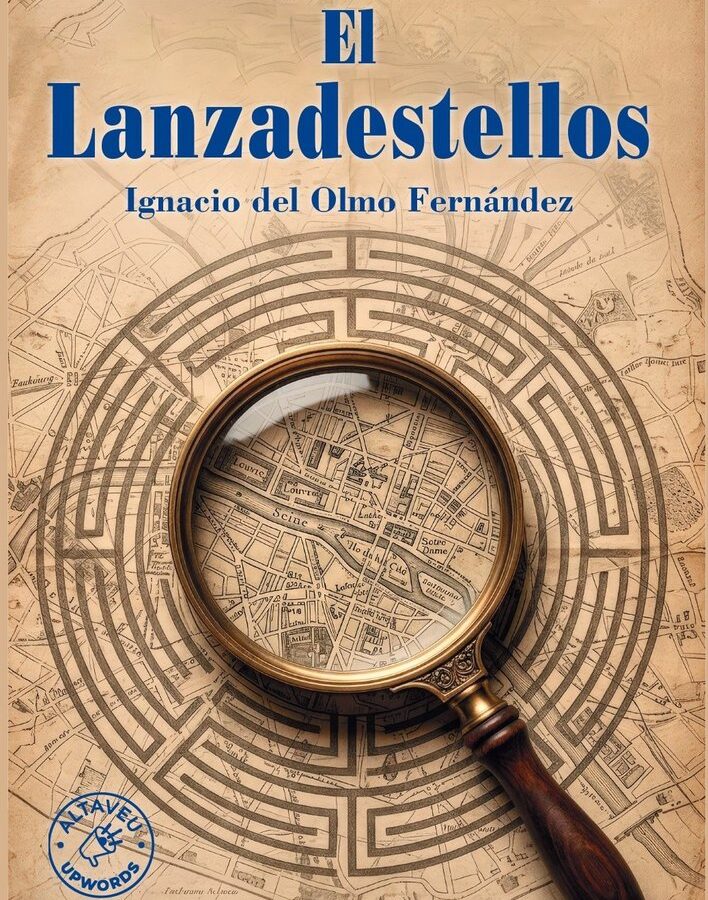
Ignacio del Olmo returns in The Lanzadestellos to the detective novel, a narrative tradition subjected since its origins to a fruitful tension between popular entertainment and the dissection of the society that produces it. In contrast to approaches that reduce the genre to its rules, authors, and schools, Del Olmo sees it as a territory from which to observe the moral fractures of each era and, above all, our way of facing a reality that we do not always understand.
The Lanzadestellos (Upwords-Altaveu) is not an academic chronology nor a nostalgic compilation of the genre. Its question is more ambitious: what does it mean to investigate and how can we orient ourselves in increasingly complex societies? The detective novel thus appears not only as escapist literature but as a form of knowledge in which detective and reader share a task: interpret clues, formulate hypotheses, err and seek again.
The Humanist Policeman, a Two-Faced Gaze
One of the most singular features of The Lanzadestellos lies in the stance of its author. Ignacio del Olmo blends extensive professional experience as a police officer with a humanistic view of literature and society. That dual perspective allows him to read literary crimes from the experience of someone who knows the distance that exists between suspecting and proving, but also from philosophy, literature, and the social sciences. Borges and Umberto Eco, among others, thus participate in a conversation that goes beyond the conventional boundaries of the genre.
This professional experience also introduces a fundamental distinction. The literary detective may permit intuition; real investigation must transform suspicion into evidence and then subject it to the safeguards that allow the construction of a procedural truth. Fiction and reality draw near, but they never become confused.
From Poe’s fingerprint to the posthuman algorithm
The journey of The Lanzadestellos traverses the successive transformations of crime fiction. It begins with Dupin and Sherlock Holmes, when the enigma could be resolved through the exercise of reason; it passes through the rupture of the hard-boiled by Hammett and Chandler, where the detective discovers that solving a crime does not mean repairing a corrupted society; and it arrives at a present marked by data, surveillance, and artificial intelligence. The question becomes inevitable: what remains of the old detective when the algorithm can also search for clues?
The very structure of the book participates in that idea. The Lanzadestellos can be read linearly, but it also invites detours among authors, eras, disciplines, and problems. Its fractal architecture makes certain questions — how we investigate, how we interpret the clues, how we distinguish truth from error — reappear at different scales and in different forms. The labyrinth thus ceases to be merely an object of study and becomes a way of reading, each chapter offering connections and flashes with which the reader can build their own path. Therein lies perhaps the most suggestive proposal of the essay. The history of detective fiction ends up becoming a history of our ways of seeking the truth. From fingerprint and deduction to data and the algorithm, the tools change, but the same need remains: to orient ourselves in the midst of uncertainty.
The Lanzadestellos offers some bursts of light to navigate that labyrinth. The definitive map, fortunately, remains in the hands of the reader.
———————
Title: The Lanzadestellos. Author: Ignacio del Olmo Fernández. Publisher: Upwords-Altaveu. Purchase: Todostuslibros.