
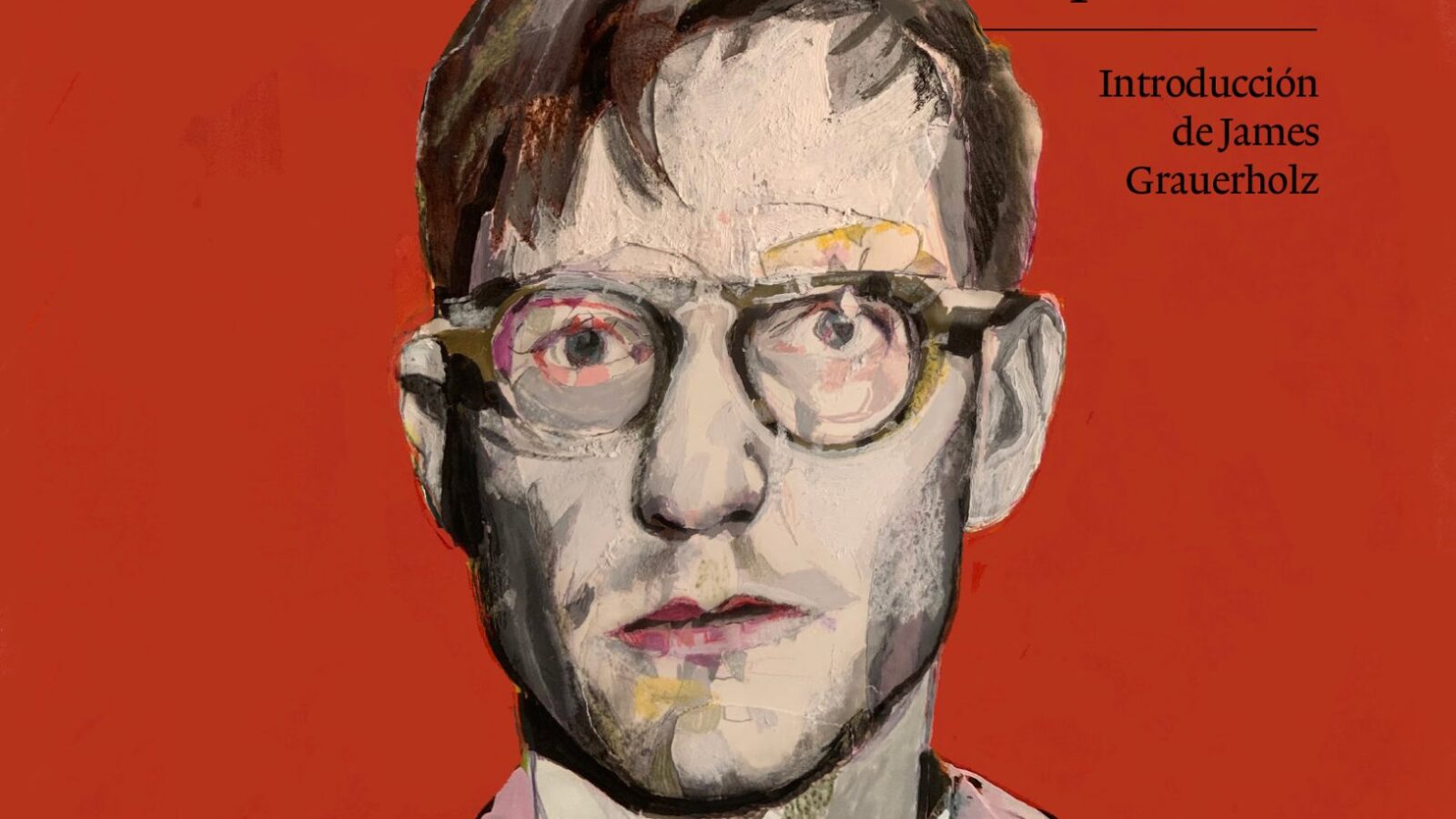
William S. Burroughs wrote The Nova Trilogy —The Soft Machine, The Ticket That Exploded and Nova Express— as a revolutionary manifesto against power structures, a guerrilla warfare against the language of the media.
In Zenda we reproduce part of the Introduction that James Grauerholz wrote for this edition of The Nova Trilogy (Anagrama), by William S. Burroughs.
*****
THE CUT-UPS
In 1960, based at the Empress Hotel in London, from which he visited Ian Sommerville (who had returned to study at Cambridge), William Burroughs began to create his “cut-up trilogy”: The Soft Machine, The Ticket That Exploded and Nova Express. He mixed new pages with old writings, cutting from his past to write a future still unimaginable. His editors fought legal and literary battles on his behalf, even after realizing that these new texts were not as accessible to his growing audience as Naked Lunch, a novel whose large doses of satirical humor, sexual material, and allusions to drugs proved especially appealing.
With fame also came admirers. Michael Portman, seventeen, was the first of them. He pursued the author in the autumn of 1960 and grew irresistible. But ‘Mikey’ was a problematic boy from English high society, and he tried to outdo Burroughs in the consumption of narcotics and alcohol during the roughly three years he stayed close to the circle formed between London and Tangier. He died in his thirties, a casualty of what Brion Gysin termed “miserable excess.”
One relationship that, on the contrary, would accompany the author throughout his life—though, like many of his important friends, it began on a rough note—arrived in the form of a letter. It was sent by Dr. Timothy Leary, a psychologist who soon focused all his attention on the relatively new field of psychedelic drugs, which he called “psychedelics” because they could “expand the mind.” The history of the use of these substances touches on fascinating aspects of anthropology and pharmacobotany, as well as a political intersection with the CIA as a “machine of control,” whose secret LSD experiments were widespread during the fifties and sixties, as would be revealed later. Of course, Burroughs’ early interest in ayahuasca had already made him aware of its properties, and Leary took note. In early 1961 he sent London some psilocybin mushrooms at a moment when the writer planned to spend the summer in Tangier with Ian Sommerville.
Allen Ginsberg and Gregory Corso arrived in Tangier in June of that year, just as The Olympia Press was publishing The Soft Machine in Paris. Alan Ansen soon joined the group, and everyone was already consuming a mix of psychedelic drugs in the name of spiritual discovery. Leary landed there in midsummer and convinced Burroughs to join him in Newton, Massachusetts, for a month. Corso, Ansen, and Ginsberg left Tangier in September, while Burroughs flew to Boston to participate in Leary’s experiments. But Leary was entering a messianic phase and, after a few weeks, the disputes between them became ongoing.
Meanwhile, his publishers in France, England, and the United States were waging several legal battles over the right to print their books (as well as those by Henry Miller, James Joyce, Frank Harris, Vladimir Nabokov, and J. P. Donleavy) and Burroughs took advantage of the gaps between editions to rewrite. After the appearance of The Soft Machine in Paris in 1961, he significantly expanded the text for publication by Grove in New York (1966) and again for the London edition by John Calder (1968), resulting in three distinct versions of the novel. The Ticket That Exploded was printed in Paris in 1962; for Grove’s 1967 edition Burroughs expanded the text, but left it as is for Calder’s 1968 edition, so there are only two versions of this work. Grove was the first to publish Nova Express, in 1964, while the British edition (unchanged), two years later, was handled by Jonathan Cape Ltd., because the writer’s British agent was reluctant to grant Calder the publishing monopoly.
As Barry Miles noted in his 1993 biography of Burroughs, the new material in the second and third versions of The Soft Machine, as well as the second version of The Ticket That Exploded, contains passages that serve as a bridge to the author’s next literary phase: a controversial period that coincides with his erotic renaissance at the start of his fifties. For this compilation the American editions have been used.
——————
Author: William S. Burroughs. Title: The Nova Trilogy. Translator: Rodrigo Olavarría. Publisher: Anagrama. Sold by: Todostuslibros.