
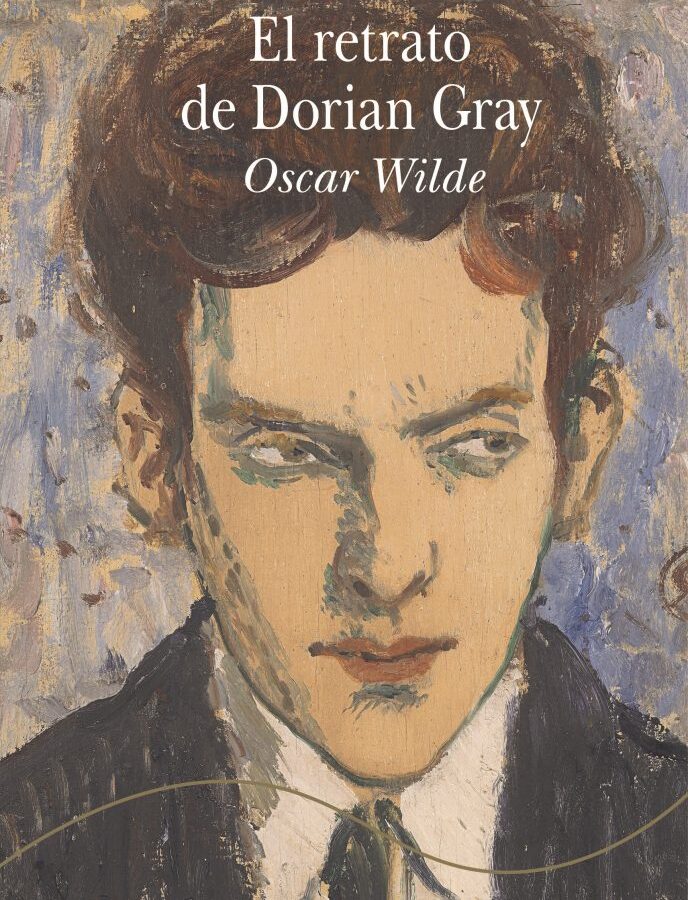
A young man of extraordinary beauty longs to preserve his youth for ever, even as his portrait ages. From this premise, Oscar Wilde builds a moral tragedy about hedonism, corruption, and the power of the conscience.
At Zenda we offer the opening pages of The Picture of Dorian Gray (Alba), by Oscar Wilde.
*****
CHAPTER 1
The intense scent of roses filled the studio, and when the soft summer breeze rustled the trees in the garden, the deep fragrance of lilac or the most delicate aroma of hawthorn blossoming with pink flowers wafted in through the open door. From the corner of the divan upholstered with Persian carpets where he lay, smoking cigarette after cigarette—as was his habit—Lord Henry Wotton glimpsed the glow of the laburnum clusters, sweet as honey and golden as honey, whose tremulous branches barely bore the weight of such flaming beauty; and from time to time, the fantastic shadows of birds in flight were traced on the long natural silk drapes of India hanging before the window, producing a kind of ephemeral Japanese effect that made him think of those painters from Tokyo, with jade-like pallor, who, using a necessarily static artistic medium, attempt to convey a sense of movement and speed. The sullen drone of bees struggling to make their way through the tall grasses or buzzing with tedious insistence around the golden trumpets of the lush honeysuckle, covered with a fine powder, intensified the oppressive sense of stillness. The soft roar of London was like the bass register of a distant organ. In the center of the scene, on a vertical easel, rested the full-length portrait of a young man of extraordinary beauty, and in front of the canvas, at some distance, sat the artist, Basil Hallward, whose sudden disappearance a few years earlier had shocked society and given rise to so many and varied rumors. While gazing at the attractive and elegant figure he had so deftly captured in his work, a smile of satisfaction, seemingly ready to linger for a moment, illuminated the painter’s features. But he rose abruptly and closed his eyes, pressing his fingers over his lids as if to imprison in his brain some strange dream from which he feared awakening.
—It is your best work, Basil, the best you have ever done,—Lord Henry said with a languid intonation—. You must exhibit it next year in Grosvenor Gallery. The Royal Academy is too grand and too vulgar. Whenever I go there, there are either so many people that I cannot see the paintings, and that is dreadful, or there are so many paintings that I cannot see the people, which is even worse. Grosvenor Gallery is the best place for it.
—I do not think I shall exhibit it anywhere,—the artist replied, tilting his head back in that peculiar way that always made his Oxford friends laugh.—No, I shall not exhibit this portrait anywhere.
Lord Henry, raising his eyebrows, looked at him with astonishment between the slender wisps of blue smoke that, as they drifted from his opium-laden cigarette, coiled into such capricious shapes.
—Aren’t you going to exhibit it anywhere? Why, my dear fellow, do you have some motive? You painters are capable of anything to gain notoriety, and once you have obtained it, you seem to wish to get rid of it. And that is foolish, because in this world there is only one thing worse than not being spoken of at all, and that is never being spoken of. A portrait such as this would place you far above all the young English painters and would arouse the envy of the old masters, if the old masters still feel any emotion at all.
—I know you will laugh at me,—Basil Hallward said—, but I truly cannot exhibit this portrait. I have put too much of myself into it.
Lord Henry stretched himself on the divan and laughed.
—Yes, I knew you would laugh; anyway, it is the plain truth.
—Too much of yourself! Frankly, Basil, I did not think you could be so vain; and the truth is I see no resemblance between you, with your harsh, sharp features and hair as black as coal, and this young Adonis, who seems fashioned of ivory and rose petals. Come now, dear Basil, that boy is a Narcissus, and you… yes, naturally you have a certain intellectual air and all that… But true beauty ends where the intellectual air begins. Intelligence itself is a kind of exaggeration and disturbs the harmony of any countenance. The moment one sits down to think, the whole of him becomes a nose, or a forehead, or something dreadful. Look at the successful men in any educated profession. They are all hideous! Except those in the Church. Of course, those in the Church do not think. An eighty-year-old bishop still says the same things he was told to say when he was eighteen, and the natural consequence is that he always remains absolutely charming. Your mysterious young friend, whose name you have never told me but whose portrait fascinates me deeply, never thinks. I am absolutely certain. He is a brainless being, but of astonishing beauty, who should always be here in winter when we have nothing to admire, and also in summer, when we need to refresh the intellect with something. Do not flatter yourself, Basil: you are nothing like him in any way.
—You do not understand me, Harry,—the artist said.—Of course I am not like him. I know that perfectly well. In fact, I would regret being like him. Do you shrug your shoulders? I am telling you the truth. There is a certain fatality in every physical or intellectual distinction, the same fatality that, it would seem, haunts the wavering steps of kings throughout history. It is better not to be different from others. The ugly and the dull fare the best in this world. They can sit comfortably and enjoy the spectacle with their mouths open. If they know nothing of triumph, at least they spare themselves the experience of defeat. They live as we should all live: carefree, indifferent, and free from worry. Moreover, they neither ruin others nor are ruined by others. You, however, Harry, with your rank and wealth; I, with my intelligence, whatever it may be, and with my art, whatever it costs; and Dorian Gray, with his charm: we are all destined to suffer for the gifts the gods have granted us; we will suffer greatly.
—Dorian Gray? Is that his name?—asked Lord Henry, crossing the study to approach Basil Hallward.
—Yes, that is his name. I did not intend to tell you.
—And why not?
————————
Author: Oscar Wilde. Title: The Picture of Dorian Gray. Translation: Catalina Martínez Muñoz. Publisher: Alba. Available from: Todostuslibros.