
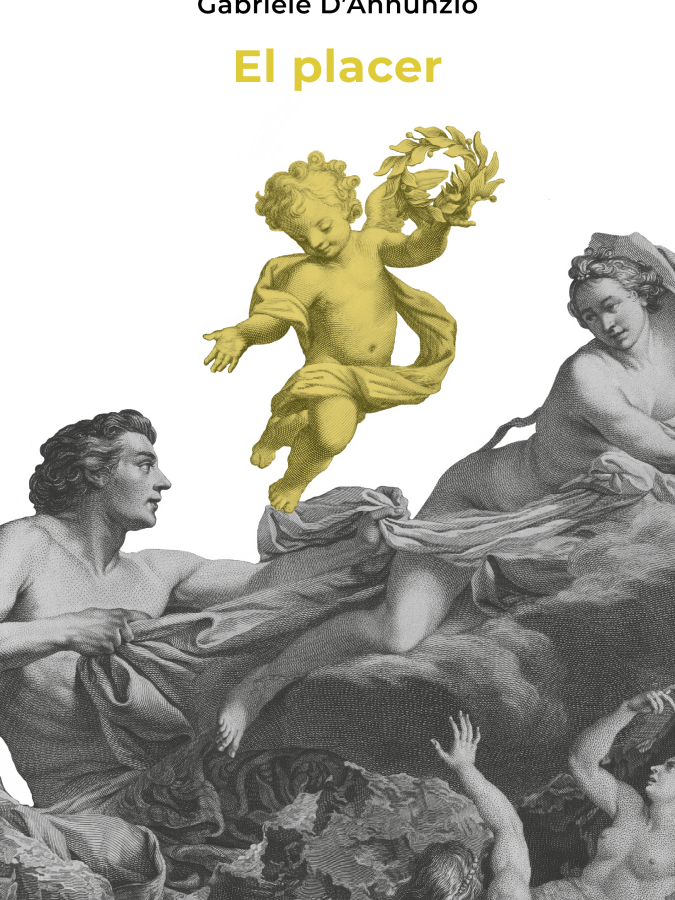
The ambitions, contradictions and fragilities of Andrea Sperelli lie at the heart of The Pleasure, Gabriele D’Annunzio’s first great novel. An aristocrat of ancient lineage, cultivated and refined, Andrea embodies the ideal of the decadent aesthete, convinced that life must be shaped as a work of art.
In Zenda we publish the opening pages of The Pleasure (Caleidoscopio), by Gabriele D’Annunzio.
***
I
The year was dying away, very softly. The San Silvestro sun poured out some veiled warmth, exceedingly gentle, golden, almost springlike, over the Roman sky. All the streets were crowded as on May Sundays. Through Piazza Barberini and Piazza di Spagna a multitude of carriages passed in single file, forcing their way; and from the two squares the muffled, constant noise, climbing up Trinità dei Monti, along the via Sistina, reached the rooms of Palazzo Zuccari, but softened.
The rooms were gradually filling with the scent exuded by fresh flowers in the glass vases. The plump, dense roses lay immersed in crystal goblets perched on a delicate stem of gold that widened into an adamantine lily shape, like those that appear behind the Virgin in Botticelli’s tondo in the Borghese Gallery. No other form equals such elegance: the flowers, enclosed in that transparent prison, seem almost to spiritualize themselves and to convey a more perfect image of a devotional or loving offering.
Andrea Sperelli waited in his rooms for a mistress. All surrounding things revealed a particular meticulous loving care. The juniper log burned in the fireplace and the tea table stood prepared, with cups and majolica saucers from Castel Durante adorned with mythological scenes by Luzio Dolci, antique forms of inimitable grace, where beneath the figures were inscribed in cursive black lacquer hexameter verses from Ovid. The light entered softly through the red brocade curtains with threads of silver, and as the afternoon sun struck the crystals, the florid weave of the lace drapes traced itself on the carpet.
The clock of Trinità de’ Monti struck three-thirty. Half an hour to go. Andrea Sperelli rose from the divan where he had stretched himself and went to open one of the windows; then, he walked a few steps around the room; then he opened a book, read a few lines, closed it; then, he searched for something else with a hesitant gaze. The urge to wait pricked him so sharply that he had to move, to do something, to distract the inner sorrow with a tangible act. He bent toward the fireplace, took up the tongs to coax the fire, added another piece of juniper to the grate. The grate stirred; the glowing embers rolled toward the metal plate guarding the carpet; the flame split into a multitude of blueish tongues that disappeared and reappeared; the embers smoked.
Then rose in the expectant spirit a memory. Right before that hearth Elena liked to linger, before dressing, after a spell of intimacy. She mastered the art of piling a lot of wood on the tusks. She would seize the heavy tongs with both hands and lean her head back a little to avoid the ashy sparks. Her body on the carpet, in that moment somewhat fatigued by the muscular movement and the shifting shadows, seemed to smile in every joint, in every fold, in every hollow, bathed in an amber pallor that evoked Correggio’s Danaë. And indeed her limbs bore a somewhat Daphne-like grace, her hands and feet small and flexible, almost arboreal, as in the statues of Daphne at the very dawn of the metamorphosis imagined.
Hardly had she completed the act when the wood caught and emitted a sudden glow. In the room, that warm reddish light and the icy twilight entering through the panes fought for a while. The scent of burned juniper muddled the head. Elena seemed seized by a childlike frenzy at the blaze. She had a somewhat cruel habit of shedding, at the end of each amorous encounter, all the flowers from the vases onto the carpet. When she returned to the room, after dressing, as she adjusted gloves or fastened a brooch, she would smile amid that devastation; and nothing matched the grace of the gesture she always repeated when she slightly lifted the hem of her skirt and first one foot, then the other, to help her enamored companion tie the laces of his still-loose shoes.
The place had scarcely changed. From every object Elena had touched or looked at arose a multitude of memories, and the images of distant times surged anew. After nearly two years, Elena was about to cross that threshold once more. In half an hour, surely, she would have arrived, would have sat down in that easy chair, drawing back with a breath, as before; and would have spoken. All the things would have heard her voice again, perhaps even her laughter, after two years.
The day of the great farewell was March 25, 1885, outside Porta Pia, in a carriage. The date had imprinted itself, indelibly, on Andrea’s memory. Now, as he waited, he could recall all the events of that day with flawless lucidity. The nomentano landscape opened before him, bathed in an ideal light, like one of those dreamlike scenes in which things seem visible from afar thanks to a radiance that extends from their forms.
The closed carriage advanced with a uniform clatter, at a trot: the walls of the old patrician villas passed by the windows, pale, almost wavering, with a steady, smooth motion. From time to time a great iron gate appeared through which a winding path bordered by tall boxwood could be seen, or a cloister of greenery inhabited by Latin statues, or a long vegetal corridor where here and there a few sunbeams smiled faintly.
Elena kept silent, wrapped in a wide mink cloak, with a veil over her face, her hands covered by suede. He inhaled the delicate scent of heliotrope that emanated from her precious fur while feeling the arm pressed against his own. The two believed themselves far from everyone, alone; but suddenly the black carriage of a prelate would pass, or a horseman, or a group of clerics in purplish robes, or a flock of cattle.
At half a kilometer from the bridge she said:
—Let us get down.
In the field, the cold, clear light seemed like spring-water; and, as the trees swayed in the wind, it seemed, by a visual illusion, that their movement communicated to all things around.
She said, pressing herself against him and hesitating on the rough ground:
—I’m leaving this afternoon. This is the last time…
Then she fell silent; then she spoke again, at intervals, about the necessity of her departure, about the necessity of separation, with a tone filled with sadness. The furious wind snatched words from her lips. She continued. He interrupted her, taking her hand and seeking with his fingers among the buttons the bare skin of her wrist:
—Enough! Enough!
They pushed forward, contending with the intrusive gusts. And he, beside the woman, in that high and grave solitude, suddenly felt as if the pride of a freer life, a superabundance of strength, entered his soul.
—Don’t go! Don’t go! I still want you, always…
He undressed her wrist and insinuated his fingers into the sleeve, tormenting the skin with a restless movement that manifested a longing for grander pleasures.
She directed one of those gazes that intoxicated him like goblets of wine. The bridge was near, red under the sun’s glow. The river seemed motionless and metallic along its sinuous length. Reeds bowed at the shore, and the waters lightly slapped against stakes driven into the mud perhaps to hold the lines.
Then he began to rekindle her with memories.
[…]
—————————————
Author: Gabriele D’Annunzio. Title: The Pleasure. Translation: Ángel Crespo. Publisher: Caleidoscopio. Availability: Todos tus libros.