
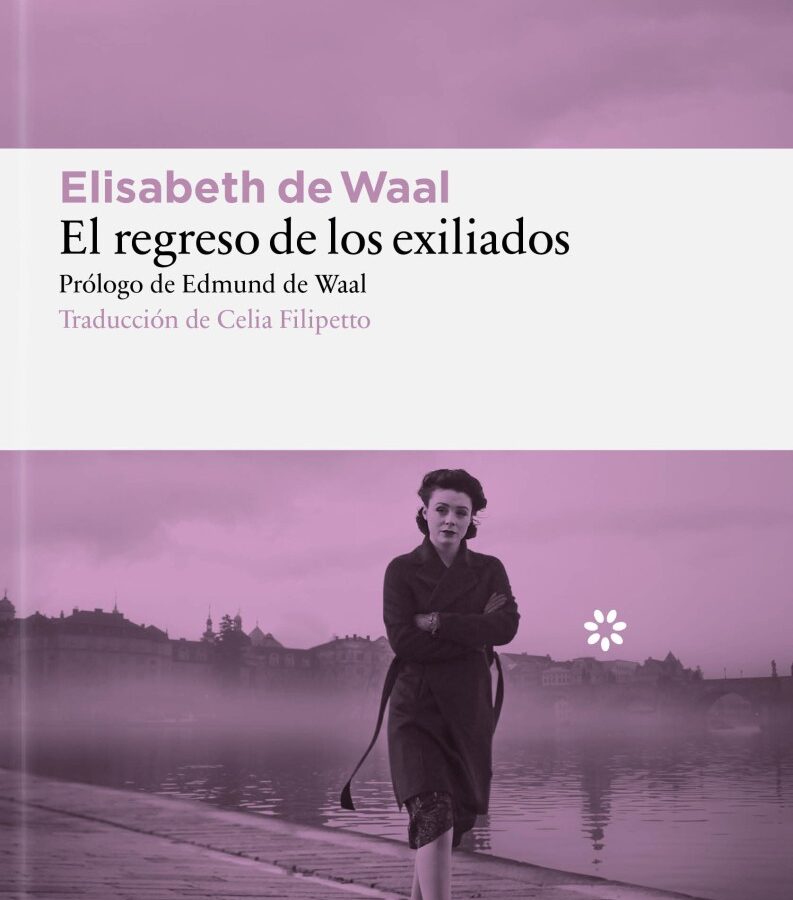
The story of a manuscript can also be a story of exile. In The Return of the Exiles, by the Austrian intellectual Elisabeth de Waal (Vienna, 1899-1991), the text that survived for decades in a sheaf of yellowed pages seems to reproduce the fate of the characters who populate its pages. Written in English in the late fifties, it remained unpublished until 2013, twenty-two years after the author’s death, when her grandson Edmund de Waal rescued it and published it with Persephone Books. This literary revival complements the family chronicle of The Hare with Amber Eyes, connecting with the looted rooms of the Palais Ephrussi on Vienna’s Ringstrasse.
The painful experience of uprooting permeates the work.
Vienna emerges as a wounded city, its façades recalling rows of chipped teeth. Its inhabitants live with material scarcity and extreme precarity. To survive, Vienna’s residents practice voluntary collective amnesia, a pact of silence about the atrocities of the recent past. The returning exiles encounter a desolate and hostile landscape, reflecting a collective moral devastation.
The dramatic structure rests on the interweaving of three existential trajectories in the occupied Vienna. Kuno Adler, a prominent Jewish scientist, returns from his exile in New York with the longing to resume his research, compelled to live with the specter of impunity by former regime collaborators. Theophil Kanakis, a wealthy merchant of Greek origin, returns to expand his fortune in the real estate business, surrounding himself with figures stripped of the old nobility such as the young Lorenzo “Bimbo” Grein, with whom he begins an affectionate relationship. Joining them is Marie-Therese, known as “Resi,” a young woman of princely lineage raised in the United States, sent by her family to reconnect with her Austrian roots. The lives of the three returnees intersect in Kanakis’s salons, weaving a network of attractions, moral commitments, and class tensions that advances toward a tragic destiny.
>The lives of the three returnees cross paths in Kanakis’s salons, weaving a network of attractions, moral commitments, and class tensions that lead to a tragic fate.
The enduring value of the novel lies in its ability to illuminate a period scarcely explored by literature: postwar Austria in 1954 and 1955, just before the signing of the State Treaty that restored sovereignty to the country. In contrast to the cinematic Vienna of The Third Man, by Carol Reed and Graham Greene, saturated with physical ruins, the black market, and conspiracies, Elisabeth de Waal’s proposition shifts toward moral ruin. The author portrays a city that masks its scars with a layer of courtesy and calculated amnesia, where silence is the obligatory currency for daily coexistence.
In this topography of silence, the presence of the returnees acts as an uneasy mirror: they embody what Viennese society needs to forget in order to rebuild its normality. Those who fled Nazi horror after the 1938 Anschluss return bearing survivor’s guilt, far from any halo of victory or heroism. Upon their return, they encounter a society that has rewritten its own history to present itself as a victim of the regime, rather than as an accomplice or indifferent observer. De Waal portrays this collective silent pact with irony. The Return of the Exiles is a novel that eschews direct ideological discourse; ethical tension hides in everyday interactions, in the ease with which antisemitism has receded to the underground, waiting for the moment to reappear.
The author formulates the thesis that exile is an irreversible condition, for physical return does not always permit healing the wounds of history. While some characters manage a fragile ethical survival, the old Viennese order ultimately yields to tragedy and collective moral amnesia.
The work functions as a testimony to the collapse of old European hierarchies and the imposition of a new social order supervised by the Allied occupying forces, especially the American ones. The former princes live in the penthouses of their confiscated former residences, while watching as new magnates acquire at bargain prices the artistic heritage of the dispossessed.
De Waal, who maintained a lyrical correspondence with Rainer Maria Rilke, seems to have inherited from poetry an unwavering faith in the power of suggestion. That confidence translates into an aesthetic of elision and restraint that bears a deep resonance with the world she depicts. Her sober prose, with aristocratic elegance, shuns sentimentality and allows the force of the narrative to emerge as much from what is said as from what remains unnamed.
The Return of the Exiles transcends the label of historical drama. It invites reflection on the trauma of loss, the persistence of guilt, and the impossibility of total restitution. The returnees feel strange in their own home, while those who chose to stay perceive them as a living accusation of their complicity. Elisabeth de Waal thus bequeaths us a novel that, like the characters it portrays, suffered its own exile: it remained for decades in a drawer until it could return and finally occupy the place it deserved in postwar European literature.
—————————————
Author: Elisabeth de Waal. Title: The Return of the Exiles. Translation: Celia Filipetto. Publisher: Libros del Asteroide. Sales: Todos tus libros.