
The Alaska Bar in Palencia opened its doors on July 17, 1936. The following day, the Moroccan military uprising spread to the peninsula and the civil war began to take shape, but I suppose none of the attendees at the inauguration could have imagined that the world was about to come crashing down. The establishment was located on Calle Mayor, in a building designed by Jerónimo Arroyo, and until then had belonged to a man named Marcelino Touchard, who ran it under the name of El Norte. Castor Rebollo took charge of the business and decided to rename it with a more concise allusion to northern latitudes, and it cannot be said that it was a bad idea when one thinks that, ninety years later, the Alaska remains in the same place, in the hands of the third generation of the family, and one can walk in there and have a wine and prawns in gabardine batter between those walls that are barely short of a century old. I like to think that this is one of the great virtues Palencia can boast, because in that city even time seems to have learned to behave with a certain education.
Whether parsimonia is a quality that one can or should attribute to urban spaces is debatable, but I have no doubt that there are places that seem to maintain a peculiar relationship with the hours that pass. There are sites that live on the edge of the next minute, as if each moment had the obligation to justify its mere existence by adding some novelty to the one that preceded it, and others that simply settle for whatever is given. I would say Palencia belongs to the second category; not because things do not happen there, but because what happens does not feel the need to announce itself loudly, and the quiet way life unfolds presumes a discretion that, at least for those of us used to the bustle of large capitals, ends up appearing almost revolutionary. I like strolling down the Calle Mayor and letting myself drift beneath the arcades without a concrete purpose, gazing at shop windows and the façades of those buildings that preserve the best of the old provincial elegance that characterized the early steps of the last century. There is a strange beauty in cities that do not feel obliged to impress anyone, and Palencia does not intend to dazzle the visitor or persuade him that he is in a place that treasures virtues beyond the ordinary; it simply is there, with its squares and its churches, with its shops and its streets that seem to lead always to a corner where one has already been before. It is a city that does not show off, perhaps because it knows well that true elegance is the enemy of ostentation.
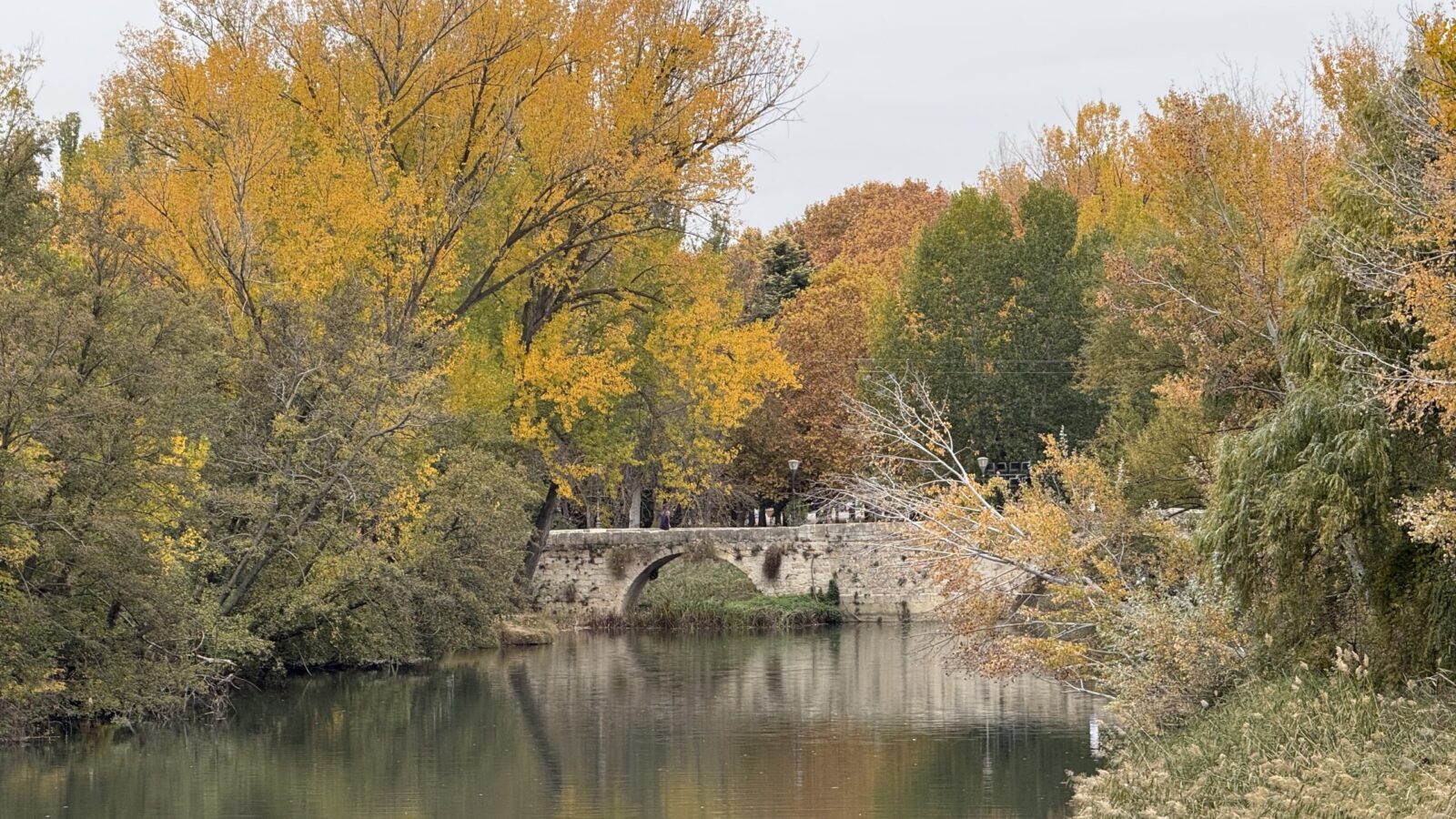
I’ve walked these lands more than a few times and I have come to the conclusion that Castilian silence is not so much about the absence of noise as it is about a particular way of listening. You hear the murmur of conversations on a terrace, the tolling of a bell, the footsteps of someone crossing a square at mid-morning, and these are sounds that never crowd one another, but seem to keep a respectful distance, as if they traced a harmony preset in an invisible score. If in big cities the noise ends up imposing itself on people, here life still asserts the right to be heard and, consequently, also the right to remain silent, which is a prerogative increasingly scarce and valuable. One can approach the cathedral, that overwhelming mass the Palencians call the Beautiful Unknown, and waste time beneath its vaults without anyone asking for a photograph. You can then continue on your way to San Miguel, peek onto the veredas of the Carrión and watch the water descend with a slowness that resembles those who walk along its banks. In the distance, the Cristo del Otero lifts its majestic silhouette over a city that does not require greater surveillance, and there is something moved by that coexistence between the grandeur of the centuries and the modesty of everyday life, between monuments that aspire to eternity and ordinary people who merely think of leaving with resolve at the vermouth hour.
However, I would not want to fall into the temptation of turning Palencia into a simplistic, picturesque scene. There will also be rush here, concerns, clashes, people who, upon waking, blaspheme and curse the city in which they have to live. The calm of small towns can be mistaken for boredom, and the tranquility that lures those of us who arrive from elsewhere will certainly suffocate some who have to endure it every day; after all, one knows the provinces well enough not to ignore that beneath their apparently placid surface there also beat frustrations, unfulfilled dreams, and the urge to pack one’s bags and set off in search of other horizons. Like all truly important things, calm depends on the perspective from which it is viewed. But there is something that has reconciled me with the world each time I have returned to Palencia, and perhaps it has to do with the realization that there still exists a way of living that does not consist in constantly chasing after something. We have been convinced that time is a resource we must manage, utilize, and monetize, and in the face of that contemporary superstition the Castilian cities offer an ancient wisdom; they remind us that an afternoon can be utterly useless and yet, precisely for that reason, be a perfect afternoon.
I return to the Alaska and think of that July 17, 1936, when Castor Rebollo, hopeful, raised for the first time the shutter of his brand-new business without foreseeing that dark times were ahead. Since then, regimes, governments, customs, and ways of speaking have changed; to change, our sense of distances has changed as well. Some countries have disappeared and others have emerged, and the world has accelerated to an extent that would have been inconceivable to the patrons who, that summer day, came to see how that place looked as it opened its doors. Yet the bar remains open, and Palencia still offers anyone who wishes to visit it the gift of its quiet hours. Perhaps eternity is nothing more than that: a place to return to, a conversation without urgency, a drink at a counter; the fleeting certainty that, at least for a while, there is no obligation to be somewhere else.