
At heart we are creatures of habit, and these habits are sometimes hard to alter. Many of these customs are negative for the individual, affecting health. Others tend toward procrastination, which likewise influences well-being and self-esteem. We live in a world that is increasingly fast-paced, where everything becomes fleeting or ephemeral, where situations are trivialized or taken for granted in many others. This is where guidance is needed, to pause for a moment and center ourselves in this moment, in this reading moment. Reflect on the present. The newer generations increasingly struggle to reach this point, resulting in frustration, lack of attention, out-of-control anger, or generalized anxiety. Therefore, it is necessary to seek elements that connect us and anchor us in the lived moment. In the here and now. And that leads to talking about methods, tools and mechanisms that were already present in the past.
According to Penguin Random House, following the SARS-CoV-2 pandemic events of 2020, there was a rise in sales of Meditations by Marcus Aurelius, one of the foundational books of that school of thought known as Stoicism, aimed at living with serenity and wisdom. What classical authors such as Epictetus, Seneca, or the already mentioned Marcus Aurelius proposed were postulates that guaranteed inner peace and tranquility of spirit.
Notably, for example, the dichotomy of the controllable: distinguishing between what depends on us and what does not. Of course, in the East and, specifically, in Japan, there are also cultural concepts that cling to gratitude, patient learning, resilience, and the pursuit of improvement.
During a conversation between Nagisa Ōshima and Akira Kurosawa, he spoke about the fact that young people do not know the trick of the journey, of the process. He made it clear: “When you are about to climb a mountain, the first thing they tell you is not to look at the summit, but to keep your eyes fixed on the ground as you ascend. You climb patiently step by step, and if you look at the summit, you will end up frustrated.”
In Japan there are various proverbs and expressions that deepen the concepts mentioned above. In writing lies the kotodama, an ancient belief by which, when you write a word, the object itself gains power. In essence, as Izumi Kyōka stated: “The power (or virtue) of letters is infinite; use it with prudence.” Ultimately, it is the person who must identify and seize what is exposed to them. It is they who generate change, who manage to decide and act.
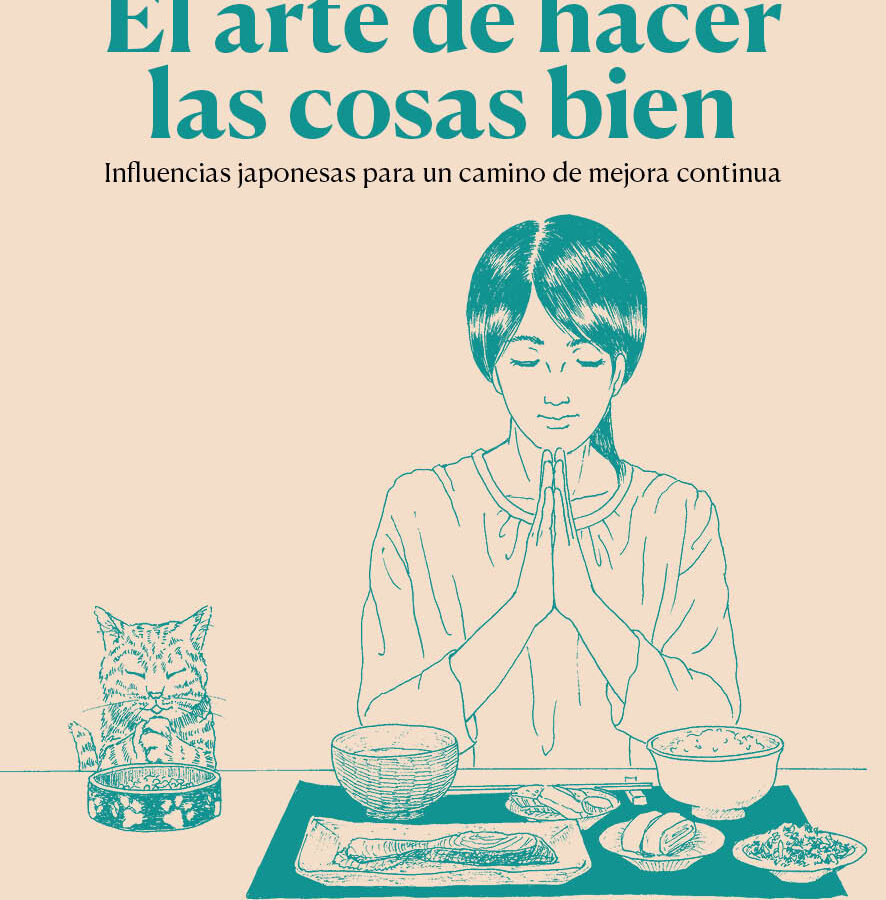
Building on all the above, it is worth discussing The Art of Doing Things Well (Satori, 2026) by Rosa M.ª Muñoz Gómez, an essay that slowly, drop by drop, delves into Japanese terms and proverbs that can serve as a guide in decision-making and action, with the aim of achieving a sense of well-being. A compilation whose format rests on four major blocks. These, in turn, are divided into nineteen chapters centered on concepts — see mottainai, oubaitori or anshin— — thus presenting a process, a path to follow, in the style of Maslow’s hierarchy of needs or Kübler-Ross’s stages of grief. With each chapter, etymological analyses of the preceding terms are explored, also delving into the form and meaning of their kanji or ideograms.
1. Attitude
The opening chapters that the author presents are, simply, the foundation of every framework. The dō or path, the techniques or jutsu. And, of course, our individuality interpreted as a unique journey, delving into the oubaitori. Yet, the beauty of this journey does not consist solely in focusing on the main point, but in exploring the details, pausing our action.
2. Learning
From here, Muñoz Gómez describes her dedication to aikidō to present reflections on perseverance, the beginner’s mindset —which allows humility, but also discovery— and the necessity of shuhari, that is, living in cyclical processes akin to an ensō, ensuring continual improvement in our aims as we traverse stages of evolution.
3. Difficulty
Not everything rests on observation, practice, and effort. To achieve something, patience and dedication, mistakes and failures are required. To sink in order to rise. This section discusses the need to take risks with conviction and a plan, to have a will that confronts the discomfort of a phase, as something necessary on the path. And, of course, to value interdependence. For example, someone suffering from depression needs someone who can advise and support them. A counselor who guides them in such a situation, while the person themselves fights their own shadow, with the firm ideal of truly living. And that is difficult, as is maintaining a business, a family, or caring for someone dependent.
4. Harvest
The final expressions are a point of convergence for all the above, seeking balance and recovery. We cling to the Buddhist idea of inga: cause and effect, within that infinite loop of the process. Thus, we need mental pause or peace between cycles, we need to value small details, marvel at the imperfection of handmade craftsmanship and not forget the power behind gratitude. All of this is explored by the author, attending to the message behind anshin, wabi-sabi or kansha.
One of my favorite proverbs from this section—and also one of the author’s—is ichigo ichie, interpreted as paying attention to the present, to each encounter as a unique experience. A reminder similar to Heraclitus of Ephesus or to the pages of A Chronicle from My Hut, by Kamo no Chōmei.
Rosa M.ª Muñoz Gómez has approached this book as a manual directed toward each person’s inner landscape, enhanced by the clean brushwork illustrations of Kaoru Katayama. Despite her hesitations in discussing personal experiences and how the foregoing has been present in her life, she has created a mirror, one that allows the reader to approach and see how all of the above transcribes onto their own path, their own journey. The author does not position herself as any guru or self-help professional. Simply because there is nothing new in what is contained here, but rather a conscious effort and approach to something marvelous: knowledge that has existed for centuries, both visible and invisible, and how words can reverberate within us. A remarkable achievement in the times we live in.
And this book manages that, once you finish it and close it, you dedicate a few seconds to thanking it for being there, so you can revisit it at a later point on the road that is life.
—————————————
Author: Rosa Mª Muñoz Gómez. Title: The Art of Doing Things Well. Publisher: Satori. Sales: Todos tus libros.