
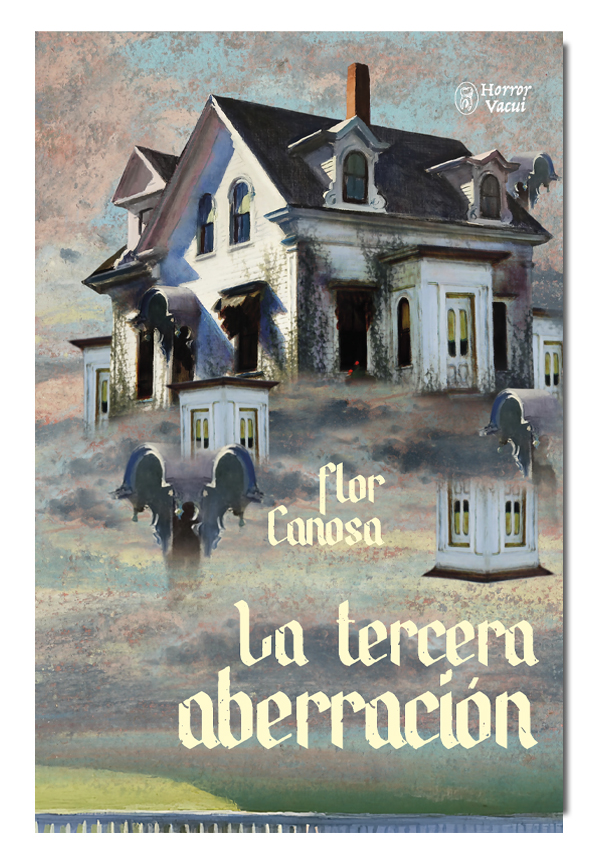
For an architect, this house would be an architectural aberration. A petit hôtel from the early 20th century that breaks every rule and presents a devilish layout. With a direct influence from The House of Leaves, by Mark Z. Danielewski, this novel blends the Gothic with the trope of haunted houses and social trauma.
What follows is an excerpt from The Third Aberration (Horror Vacui), by Flor Canosa.
*****
Entry into the Fresh Body
Sergio drags his leather suitcase up the ten marble steps, all of them covered by a carpet that once was a bold red. The ascent feels like the exhausted tongue the house extends toward the curb. He stops in front of the faded sign and rings the bell. He sets down the bag that he wears crossed over his chest. The honking on Avenida Entre Ríos arrives with urgency, or maybe it comes from Avenida Independencia; it’s hard to tell from the second hallway. Virrey Cevallos is a quiet street. Sergio waits. A cool breeze slips from inside the house, sneaking under the bottom of the door. Nothing moves inside; all movement perceived is the faint bustle and a few voices from the street. He waits. A shadow obscures the voile curtain that hides the reception, and the door opens after a long, interminable ten minutes. Nuria gives him a cursory glance. She can’t decide what to think about what she’s seeing, and that is a lot for Nuria. The look Sergio shoots Nuria is fleeting. He doesn’t want to form an impression because he isn’t interested in people who might pass through his life for five minutes. If the hotel doesn’t convince him, he won’t have to think about that blonde lady with the bun and the cold features ever again.
I’m looking for a room, says Sergio.
His voice doesn’t carry a precise timbre; it vibrates in a half-tone that sounds like a purr. It’s a voice directed inward, as if he swallowed half the sounds. Nuria smiles with tight lips and steps aside.
Go ahead, go ahead.
Sergio crosses the bag over his chest again and drags the suitcase inside.
‡
For an architect, this house would be an architectural aberration. A typical petit hôtel from the early XXth century that, however, refuses to conform to any rule, does not heed the common layouts, and is so easy to get lost inside that one could end up back where one started without thinking. Yet no architect ever enters the house; hardly any masons or day laborers do either. It is a matter of following the signs to reach a room, to reach the kitchen, the bathrooms, or the dining room. There are some handwritten instruction signs in neat handwriting that, Sergio thinks, were undoubtedly drawn by the hand of this woman. That is all one needs to understand the nameless family hotel. A house is experienced, walked through, slept in, not explained.
‡
Nuria suggests to Sergio that he leave his belongings at the reception—barely a desk beside the stairs—so they can first view the room. She guides Sergio through the two floors of the marble staircase without carpet. If the exterior looks like a tongue, this staircase could well be the teeth, worn down at the edges by the age of that mouth with almost all its pieces missing. The potential room lies at the end of the corridor. In a corner, camouflaged among the arabesques of the monotonous wallpaper, Cronos watches the visitor motionlessly. He is an adult gray cat, with a slanted yellow gaze that watches the movement with the indifference of someone who has seen it all. Sergio smiles at him with a charm that seems unnecessary for a pet whose language speaks in other codes, but he cannot resist the impulse to please, even if only to the cat.
What’s its name, he asks.
Cronos.
Cronos? How original.
There’s a pattern to the names.
Sergio doesn’t ask anything else, he surveys the room Nuria has just unveiled to his eyes. It’s barely a rectangle, forcing the furniture to sit against the two long walls. At one end is the door and on the opposite side, a window that breathes toward the back.
That way it’s quieter, Nuria tells him, reading his gaze.
A single bed to the right, a desk on the wall opposite, and a narrow two-door wardrobe. Nothing more. The bathroom is three doors away.
The adjacent room is empty, but it has no window, so this one is better, Nuria explains. And more silence, too, the woman repeats, for whom silence seems to be the center of a personal religion.
Sergio pays for the month. He isn’t particular, and in fact this hotel is a bit better than he imagined given the price. It looks clean and calm. Quiet, he thinks, and he smiles without a single gesture. It is temporary; he will find a more suitable dwelling soon. In March he starts at the faculty, and he’ll have a future job as a junior at a law firm a few hours a day. He tells Nuria this as she decides to show him the first floor, and as she nods like she cares. She shows him the dining room, though she tells him that no one uses it, not wanting to confess that, in truth, she does not want anyone to use it and that happens almost by suggestion. There is an order in her tone. Almost everything Nuria says sounds like a demand. She seems like a German governess from a horror novel, thinks Sergio, who now watches her more closely because she is part of the landscape he has just chosen. Then she shows him the kitchen and the patio. She says that the third floor houses the family residence and that the terrace cannot be accessed, but for an extra fee she can wash, hang, iron, and deliver his clothes to his room.
‡
“The hotel is very large,” Sergio says, not clear whether it’s a question or a statement. Sometimes his monotone voice gives the impression of lacking inflections.
For Nuria, the house has twenty-eight rooms. She knows one more than most of the inhabitants. For Víctor, her husband, there are about twenty, because the storerooms never get entered, and there’s another (the room silenced by Nuria) that she does not know. Among the children, Apollo is completely indifferent to numbers, as if they didn’t belong to his cosmology. Minerva believes in the official version of twenty-seven rooms and fears each one of them. She doesn’t need to think about them or count them; she prefers to omit their existence (except for one, which bears the aura of a sanctuary), as if the space between the ground floor and the third floor were barren ground. She always goes up the stairs running, not looking beyond the next step, turning corners with her eyes fixed on the gray wallpaper. By contrast, Diana knows there are thirty-one, because she can smell them all even if they are walled up. She can smell each of those rooms swallowed by time and secrets. She knows what’s behind the bricks. Who is there. She also smells a little beyond the wall, but no one speaks of that scent.
—————————
Author: Flor Canosa. Title: The Third Aberration. Publisher: Horror Vacui. Available at: Todostuslibros.