
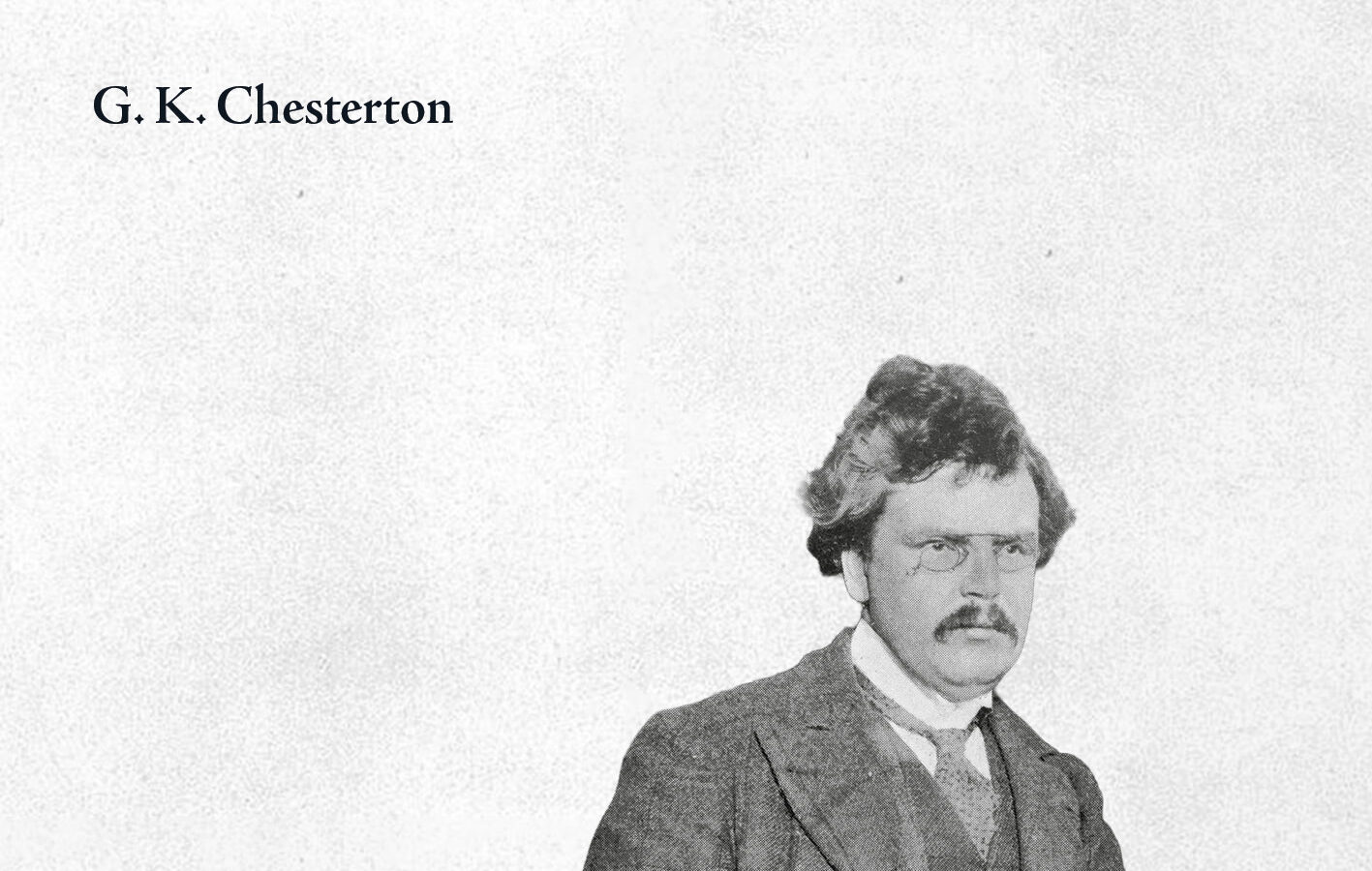
At Zenda we reproduce the Introduction toThe Victorian Era in Literature (Barlin), by G. K. Chesterton.
***
Introduction
A large portion of the finest literature can be convincingly categorized in two distinct ways. On one hand, there is writing that seems to be slicing through a raisin cake or a wheel of Gruyère: as the knife digs deeper, it encounters both fruit and holes. On the other hand, there is literature that resembles splitting a log along its grain — if, using the metaphor, we suppose there is a grain. In any case, the two possibilities can never occur simultaneously. Over time, names never appear in the order in which they present themselves in the systematic studies of a literary tendency. The criticism that aims to systematize the spirit of an era must, by necessity, move back and forth in time, much as a branch tirelessly sways in one direction while its fruit, at the same time, moves irregularly and freely in the other, as if it were the course of a wild river.
The chronological order is as arbitrary as alphabetical order. Studying Darwin, Dickens, or Browning in the order of their birth dates would be the same as placing Tacitus, Tolstoy, and Tupper within a coherent framework simply because they appear together in a biographical dictionary. Approaching them in this way might perhaps yield greater precision and, moreover, would satisfy all those critics who insist that each artist should be regarded as an autonomous creator, independent of the relationships that may have existed with others within their community, or of the possible moral questions they share. However, writing on that basis would entail the difficulty, well known to politicians, of having to publicly defend a doctrine in which I sincerely do not believe. It is unnecessary to linger here on the old debate about “art for art’s sake,” or to explain why artists cannot be understood in isolation without reference to their traditions and beliefs. It will suffice to say that with other creeds those artists would have been, in literary matters, radically different individuals. Of course, their views are not merely the result of their intellectual power. Or at least not more so than the ink contained in a pen. The power of the intellect, devoid of qualities or intentions, would be as dull as that ink: a simple wheel turning in the void. If we distinguish mindsets, we must also differentiate the various doctrines and moral feelings of each author. The mere fascination with democratic celebrations or with mourning would not turn anyone into a writer like Dickens. Yet, without those interests, Dickens would never have become a writer like Dickens: perhaps not even a writer at all. The belief that Catholicism is the most coherent of doctrines would never have turned any other into a writer like Newman. But without that certainty, Newman would never have been a writer like Newman: perhaps not even a writer at all. It is useless for the aesthete — or any other kind of “anarchist” — to insist on the individuality of the artist, beyond their attitude toward the temperament of their own era. This stance is the only thing that has any personal character, for men are never individuals: not even when they are alone.
Llegados a este punto, solo me queda acometer la tarea más delicada y complicada que pueda existir: abordar el estudio de los grandes autores victorianos, no únicamente desde el punto de vista de la cronología y los nombres, sino a través de las diferentes escuelas y corrientes de pensamiento. Esta es una tarea para la que de entrada, y con total sinceridad, me siento un verdadero incompetente. No obstante, como ya sucediera con cada una de las aventuras literarias en las que me embarqué con anterioridad, esa sensación siempre me acompaña al principio. En realidad, tranquiliza el saber que estoy haciendo algo que no muchos serían capaces de hacer adecuadamente. El principal peligro de mi enfoque reside en la tendencia inevitable a trazar un panorama espiritual demasiado extenso, en detrimento de los personajes. Ruego indulgencia si dicha panorámica profundiza demasiado en los terrenos de la política o la ética en los que las grandes obras hallaron la atmósfera propicia para su florecimiento. Si considero al utilitarismo más importante que la libertad, o si hablo más del Movimiento de Oxford que de The Christian Year. Escribo desde la moderación característica de mi tiempo, porque soy hijo de la Época Victoriana y porque simpatizo con no pocas cosas propias de su espíritu. Prometo no considerar la religión más importante de lo que fue para John Keble, o la política más sagrada de lo que lo fue para John Stuart Mill.
—————————————
Autor: G. K. Chesterton. Título: The Victorian Era in Literature. Traducción: Alberto Haller. Editorial: Barlin. Venta: Todos tus libros.