
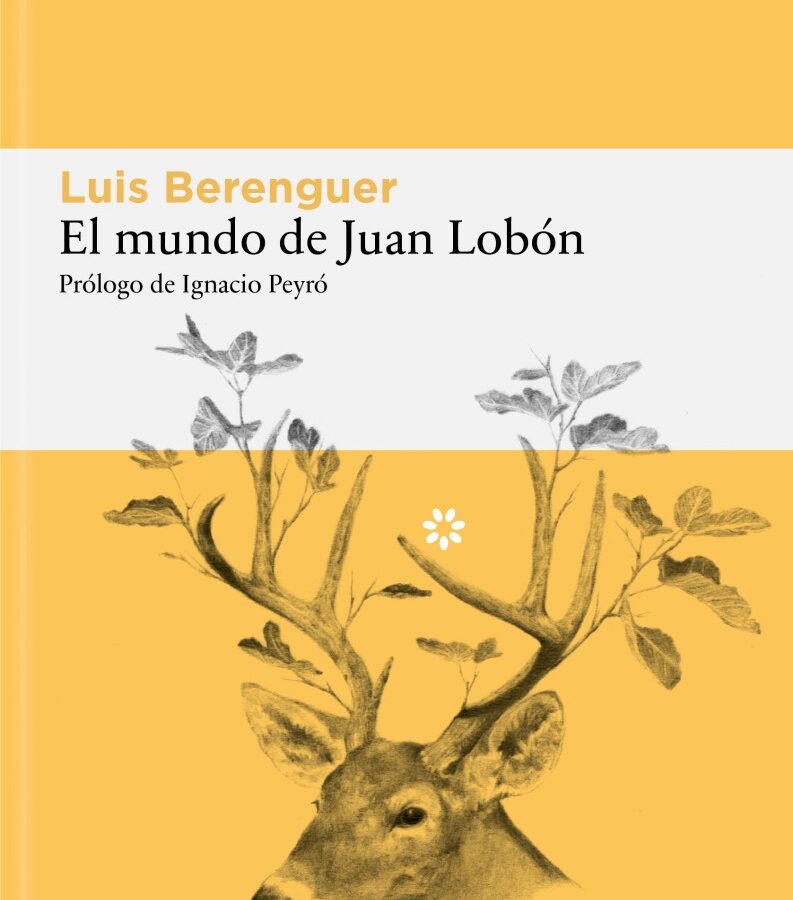
Published in 1967 and winner of the Critics’ Prize, this novel revealed a mature author as one of the most singular voices of his generation. Inspired by a real hunter, the work depicts a setting marked by inequality and poverty.
At Zenda we reproduce the opening pages of The World of Juan Lobón (Libros del Asteroide), by Luis Berenguer.
*****
Four Things to Begin With
At first the law wasn’t as it is now, which Don Gumersindo’s grandmother changed at her whim. It wasn’t like this before.
I know the gist of the old one even if I don’t know some words, which one isn’t going to remember everything. This is how it was back then:
“The wild beasts of the hills belong to everyone and to no one: to the one who traps them. There is no punishment for killing them.”
“If the owner of a land doesn’t want hunters on his property, drive the beasts away. If he doesn’t drive them away and someone enters there to hunt, there is no punishment.”
“If what the owner wants is to keep the beasts to hunt them himself, let him pay. Whatever is earned, distribute it among those who are harmed by not entering there to hunt.”
“If a man is caught hunting where another man’s land that has been paid for by someone else to keep others out is, punishment: ten cane blows. The other man has paid; no one should enter what is his.”
“If they don’t catch him, but the owner finds out when the man who entered is in the free and not in his own, punishment for the keeper of his own: ten cane blows. For the one who entered there is no punishment: he took a chance and won, already paying with fear. If the owner is the keeper, there is also no punishment; he paid with his outburst.”
“Do not take the hunter’s weapon away: it is his feet and his hands. If he deserves punishment, give him cane blows, but do not take away the weapon.”
The old law said more things, but they weren’t about hunting and it would be silly to put it all here.
I read it when I was very young, and my father soaked me in it to make me understand. That law came in a very thick book, with pictures, which my father found in the junk heap at La Zarza, a book they called The Sphere and that told everything about the world.
My father said that the grandmother of Don Gumersindo threw that book away so that no one would know what the law of truth looked like, the old one, so that no one would come to rebuke her with comparisons.
Papers change everything if you have influence and you invite this one and that one who writes them. That is what Don Gumersindo’s grandmother did, who always brought the world into turmoil with her whims.
I never liked seeing a partridge lure, and now even less, now that I know what it means to call the countryside that lies beyond the fence.
So bad is this that I have started to write.
Don Fermín, the constable, bursts into laughter when I tell him I am going to fill a book with my things. I know the pen for my own needs, and if a book is made of words I know how to put down, then Don Fermín and his laughter can go on with it.
A book about lovers, or about whores and such things, I wouldn’t say I could invent it. For that you need a lot in your head; I know it even if Don Fermín doesn’t tell me so, but about my own things, what I know, why shouldn’t I tell it?
If I were free, of course I wouldn’t write, nor waste time on trifles, for this isn’t my thing, nor would I have any reason to do it. Now I have it.
I am Juan Lobón, and I am here not to steal a cavalry, not to kill a man, nor for what would be reasonable. I was brought here because the rope always breaks at the weakest point, because justice leans toward whoever can do the most, and because the law is bad.
If they had put me in the shadows for doing my own thing, I would be in the shadows for truth, not for the lie I am living now.
I am a hunter and I am not a thief. I have always lived by my craft as others live by theirs. But no one goes to jail for castrating pigs, keeping goats, or shoeing an animal. For hunting, yes.
But if they had brought me in for hunting, if they had pressed me while I hunted in the mountains, I would have found myself in prison for the truth; not that now, for not having been able to trap in the mountains, for not having taken away the hunt, my honor is stripped and I am made a thief behind bars. It is justice, and I am not the one lying, for if it sides with Don Gumersindo, who has the most power, the reason remains on my side, even if it serves nothing.
They made the law for the old, for the lame, for those who do not know, nor can, nor are fit to fight in the mountain. God did not give pine nuts to those without teeth, nor did He give fangs to the cow, but teats.
The new law was laid against us, the hunters. That is why we have to hunt without law, because the law is bad.
Don Gumersindo’s grandmother knew a lot, but the one who wrote that law knew nothing. A bad law that does not take into account the essential thing. The poor fellow who wrote it, full of wine and gifts, could not be a hunter and he wrote on the page what they told him, without knowing what he was putting down.
I am not smarter than anyone, but as far as I can tell, if I start giving lessons in what I understand it is not out of merit that I have. In this business of hunting, nothing else, I was given very good upbringing and a father who inherited from his father and grandfather what they left me to become a man: the knowledge of the mountains.
My father was the best at his craft. Not everyone can say the same about their father, and that’s why I don’t pretend. If I had been born in the cradle of the man who wrote the law, I, too, would have been an ignorant person.
What a hunter knows, only another hunter can know, and it isn’t the same to utter something well-thought-out on a whim, as to give it the meaning of life.
With the new law in hand, I can kill the beast of the estate that comes out onto the road and I cannot kill the beast on the road that enters the estate. If the beast roams on its own, without anyone’s iron, what difference does it make, essentially, to kill it here or there?
If what I am not allowed to do is enter with a weapon into Don Gumersindo’s land, while without a weapon I enter, and I do not tread wheat or stubble, what harm does the weapon do to the field? If I do no harm to the beast, because it has no owner, and I do no harm to the field either, what is the thing the law punishes? That is why I say the law is bad.
I am not smarter than anyone, but as far as I can tell, if Don Gumersindo buys all the lands, because he has more than enough money for that and for much more, and lays boards all across the width of the world, where would we and those who wrote the law step? That is why the law is bad.
I cannot tread on cultivated land, nor on what has a roof, but everything above and below that which has no bottom, no work, no seed, I can tread. That is the land where the living go and the dead remain.
———————
Author: Luis Berenguer. Title: The World of Juan Lobón. Publisher: Libros del Asteroide. Availability: Todostuslibros.