
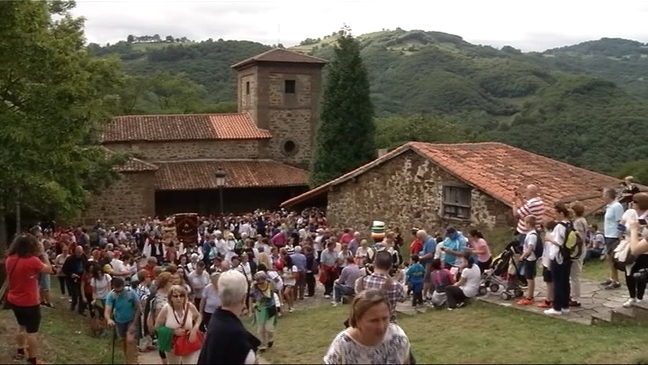
Thirty years ago they took the Martyrs from us. It was August 13, 1996. That day fell on a Tuesday, and I don’t know if the thieves noticed the coincidence, because that doesn’t seem to be the most fitting date to desecrate a shrine, but I imagine they weren’t particularly superstitious. They carried away Saint Cosmas and Saint Damian under the cover of night, while the rest of us slept, and when dawn arrived and the truth stood revealed a news story began to spread by word of mouth that bore a lot of sacrilege and a great deal of nonsense. I was fifteen and hadn’t yet read Torrente Ballester, so I couldn’t recall that memorable opening of La saga/fuga de JB — “Neighbors, neighbors, they stole the Holy Body!” — but I was quite worried because that robbery jeopardized the pilgrimage that would take place in just over a month and would surely be annulled if those two statues did not return to the hermitage. Could the Martyrs be celebrated without the Martyrs? It wasn’t, in my case, a theological matter, but rather logistical, because the September 27th feast was the one that most stirred us young people in Mieres those years. The mere possibility that it would not be celebrated would mean a catastrophe of unimaginable proportions. I suppose one has to be that age to grasp the gravity of the matter. When you are fifteen, at a major festival the whole world fits inside it. The friends, the music, the first freedoms; that feeling, perhaps now forgotten, that for a few hours — in this case, a full day — life happens precisely where you are.
While the kids worried about the important things, the adults tried to figure out what had happened and attempted to fix the mess. We learned that a carpenter who was carrying out renovations in the temple had found in the early hours of that Tuesday the 13th that the main entrance was ajar, and that as soon as he crossed it he had noticed the absence behind the main altar of the two statues of the Martyrs. Some tiles had fallen to the ground, footprints could be seen around the premises, and a window in the bell tower had been forced. A brush was missing. There was no sign of Saint Cosmas and Saint Damian. It didn’t seem that the thieves had given much thought to the robbery. The statues might have some value to us, but their market valuation wasn’t high, and nor would it be easy to get rid of them without arousing suspicion. In Mieres we all knew them, and trying to sell them there would have been like hanging the Dama de Elche on Wallapop. The Civil Guard got underway and, fortunately for everyone, the mystery didn’t last long. The images appeared the following day in a quarry at Valmurián, near Padrún. They were wrapped in plastic and showed no irreparable damage. We never fully understood who had taken them, though there were rumors, nor what they intended to do with them. Nor did it matter to us very much. The important thing was that the statues had reappeared, that they again occupied their niches in the hermitage’s altarpiece, and that consequently, this time indeed, we would have a pilgrimage that year as well.
This, as I said at the outset, happened thirty years ago. I write it, erase it, and write it again, and it still seems like a misprint to me. That teenager who in August 1996 feared missing the festival is now an adult who worries about other things, probably less important, and who in a few days will be charged with proclaiming the Martyrs’ pilgrimage. Three decades ago, such a high responsibility fell to the captain of the Benemérita who led the rescue of the images. The fact that it is my turn now indicates, or so I hope, that since then no one has set as a requirement that the town criers must prove prior service to Saint Cosmas and Saint Damian, an area in which my résumé is evidently improvable.
What I do have, at least, is memory. Sufficient to recall the restlessness of that summer when I was fifteen, the fear that those anonymous thieves would take away the happiness of September 27. It may seem, as I’ve said, a concern typical of kids, but perhaps there is something more. There are fiestas that, in some sense, measure our lives. First we attend them with our parents or grandparents. Then we go with our friends. Then we stop going. And one day, without quite knowing how, we begin to tally and discover that since the last time we laughed and danced there until now a not insignificant portion of our biography has unfolded. Perhaps that is why I remember that robbery now. Because thirty years ago Saint Cosmas and Saint Damian disappeared from their hermitage and we came to think that we would never see them again. They returned after a day and a half. I stopped going there five years later and in this quarter of a century I have never returned to visit them. I will meet them again when I go now to proclaim their festival. This time the missing one who returns will be me.