
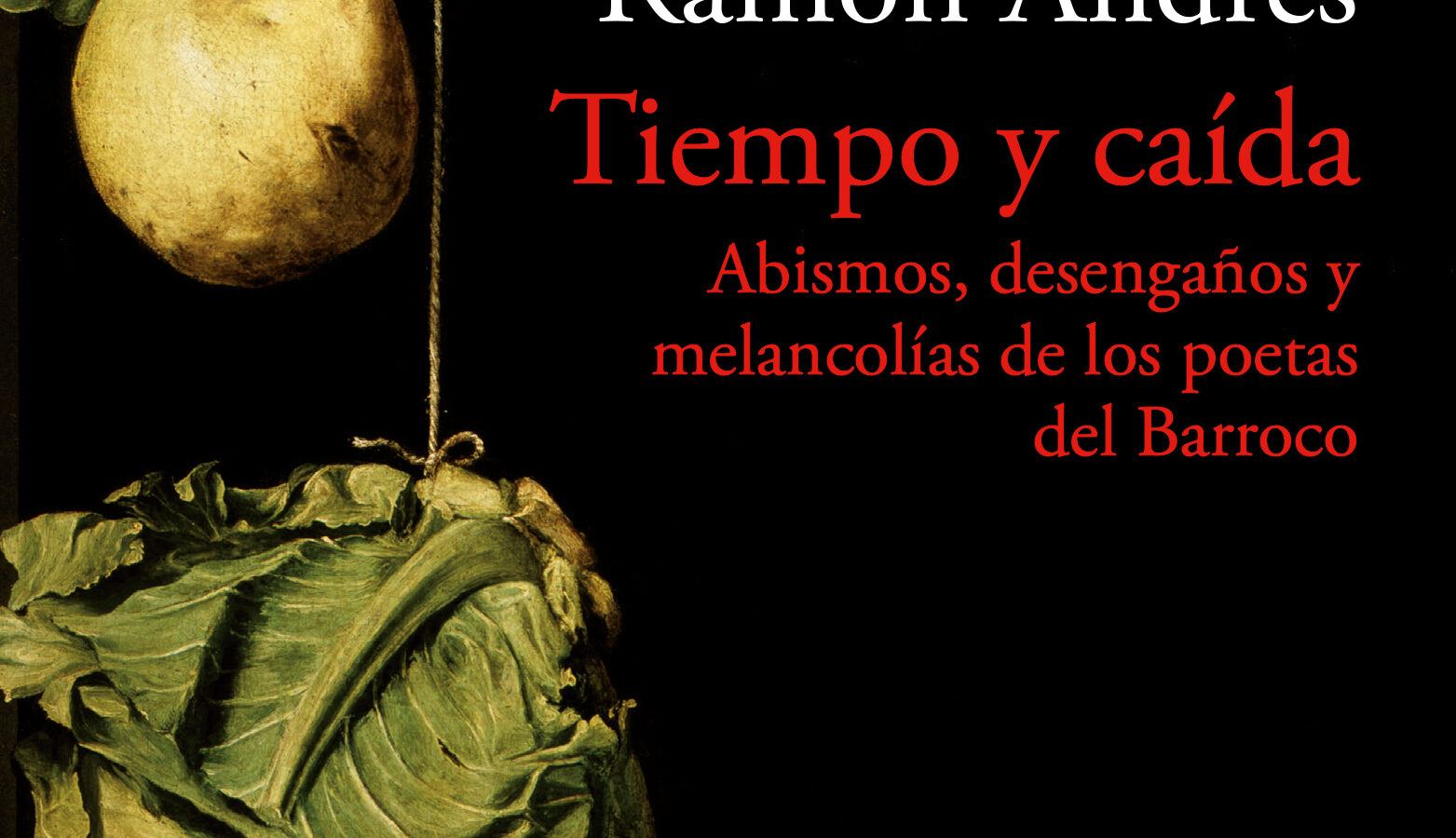
This book gathers a broad anthology of Spanish Baroque poetry, organized around the great themes and symbols of the Golden Age. Born of years of research, the volume examines the fragility of existence, the passage of time, and the spiritual concerns of an era through its most representative poetic voices.
At Zenda we reproduce the opening pages of Time and Fall: Abysses, Disillusionments, and Melancholies of Baroque Poets (Acantilado), by Ramón Andrés.
*****
PROLOGUE
1. THE CONCERTED CHAOS
It is a world of treaties on emptiness, of artificial clockworks, of candles half-burnt. There are withered flowers and skulls with the jaw agape, flies that swarm; they come from the paintings of Juan de Valdés Leal or from the poem by Francisco López de Zárate, where time writes its words on the dust laid by death.
A melancholic Mary Magdalene reflected in a mirror, a Saturn devouring his own fate, an Actaeon torn apart by his hounds. Thermoscopes, optics studies, gears and pulleys hypnotize; movement, dissections, labyrinths, abysses. The lamp of a wanderer, distant and solitary, treatises on black bile, the Cosmotheoros by Christiaan Huygens. On the table a hemisphere, some coins, a lute, dice, and apples. In the background, a parrot and a tapestry with the Tower of Babel. A seventh string for the viola da gamba; for the heavens, a new telescope.
More shadows than silhouettes, for shadows, in truth, are romantic, the realm of Jean Paul and Novalis. They relish trompe-l’œil, the idea of nothingness lying in a tomb, imagining the interior of the human body made of filaments and channels, like a machine. Monads, spheres, and more spheres, soap bubbles whose burst signals fragility, Orpheus descending to Pluto’s realms, bonfires fanned by the wind that blaze on the horizon, solitary boats that Charon has moored on the shore of all the Stygians. Courtiers, desperate poets, curtains, new navigation charts, rapiers, scores, cabinets of curiosities, stage machinery, automata, plans of Rome, elaborately adorned carriages, scattered femurs.
In the Notes on M. Arnauld’s letter regarding my proposition that the notion of the individual person contains, once and for all, what will happen to them, Leibniz writes: “It is not enough that I feel myself a thinking substance; one must distinctly conceive that which sets me apart from all other minds.”
Baruch Spinoza keeps in his library Cervantes’ Exemplary Novels; several volumes of the works of Góngora and Quevedo; the Castilian Gothic Crown, by Saavedra Fajardo; also the Treasury of the Castilian Language, by Covarrubias. El Criticón, by Gracián, is not missing. Pages, ideas, and verses intertwine with infinity and the microscope, with elliptical orbits and Robert Boyle’s air pump.
Gilbert Simondon, in On the History of the Notion of the Individual (2022), recalls what some pointed out to Descartes: “Is it not enough to say, ‘I walk, therefore I am’?” to which the philosopher replied: “No. I think that I walk, therefore I am” (p. 162).
In Covarrubias’ Treasury, printed in 1611, it is said that nature offers an irregular pearl called barrueco, named thus “for the likeness they bear to the warts that appear on the face.” This barrueco is the Portuguese Baroque, and it expresses in that tongue what is anomalous about form and existence. It is the unstable and forced, what grows haphazardly, distortion, the straight line that yields and ends in a loop: it has not been able to follow reason or the linear ray of light, because it has lost itself in a chiaroscuro.
It is in the seventeenth century when Juan de Caramuel writes the Bold Grammar, the same century of Les pleurs, by Sainte-Colombe, the same century in which John Donne, ill, asks a friend to portray him as a corpse in his coffin. A moment of chosen and honest seekers of nothingness (Miguel de Molinos), or of infamous corrupt figures, such as Francisco de Sandoval y Rojas, Duke of Lerma.
Complexity, disorder, elaborate inventions, Ariadne’s threads tangled among lives, incredible drawings, journeys into the occult, as in William Gilbert’s De Magnete. Hermit-like lives coexist with the feats of intrepid travelers. All is defined by that rare pearl; it is not, of course, the one that weighs down the careful girl in Johannes Vermeer’s painting on a calm domestic background. No, there is another Baroque that loves the antagonistic and the dissimilar, that pursues uneven surfaces, the interrupted precipices that separate plains: there is no seam attempting to join them; there is only that single disassembly of the “disjointed-disobedient” that Gerald Raunig mentions in Disassembly (2022). Its cuts recall a constant fall. Generations tumble through the abrupt regions of time, in a cascade; to exist is to hasten toward nothingness. It is the shadows of Icarus and Phaethon that approach, swiftly, to the earth, their silhouettes growing broader as they near the ground, already mingled with passersby. They are encompassed. They, too, head toward death. Existence splits, as clock hands do when they part in search of the hours.
In the Baroque, chained to the Western tragic thought, things stand at “the limit of what is possible,” as Georges Bataille would say. Everything turns in discord and resolves itself in opposition, in confrontation, a knot that looses more than it binds. Delving into those days is to walk into Giorgio Manganelli’s disturbing “definitive morass,” a viscous swamp of pools and fermenting surpluses. “I no longer remember what I believed,” he writes.
Now, in the seventeenth century, no one remembers what they believed. The first signs of a waning of religion and of the metaphysics of truth appear, and the fall is, inescapably, contemplated. Arguments for Oswald Spengler.
———————
Author: Ramón Andrés. Title: Time and Fall: Abysses, Disillusionments, and Melancholies of Baroque Poets. Publisher: Acantilado. Sales: Todostuslibros.