
One dies when the things that sustain him, often unknowingly, vanish. The friends from the square scattered to different places to settle there at someone else’s expense; those summer camps ended and the color of the ocean is no longer so blue; it’s impossible to dance that Radio Futura song again while flirting with the sweet girl you’ve just met or with the charming boy who sits beside you in the classroom. Time runs, and with that curse have passed before our lives everything that smelled of sincerity. It is difficult to find anything that doesn’t carry a hint of farce, unless, for example, that which in cinema is its very essence of farce. Fortunately we can rewatch John Ford’s films or discover Michel Haneke’s. Perhaps where that pity, that damage, is most clearly seen is in journeys, because surely it’s no longer possible to become a real traveler. The statement “I like to travel” would be impossible to utter if people exposed the more apt expression: “I like to go sightseeing.” No one enjoys feeling like a tourist, but everyone loves posing for a photo with the Taj Mahal to post on Instagram. Travel has become instagrammed, and thus it covers every corner of the planet. Hence the deduction that, certainly, traveling is a desire right now.
About that desire, about that illusion, Hilario J. Rodríguez (Santiago de Compostela, 1963) writes this essay, in which sensitivity is what dominates. To feel that one has moments of travel, one must recognize that something travels through one’s sensibility in a channel. But sensitivity is not an inert being that we carry inside. Sensitivity requires learning for which standing still is not useful. Therefore it is worthwhile to move to other places, also with the mind, as the author does when tackling his readings. The work, in fact, begins with references to one of the most intriguing travel books ever written, Atlas of Remote Islands, by Judith Schalansky. It is a work that anyone would have liked to conceive and carry out, in other words, it is about reconnecting with desire. But Schalansky will not be the only author to reach us through the writer, for Borges, Sebald, Solnit or Kapuściński also circulate here.
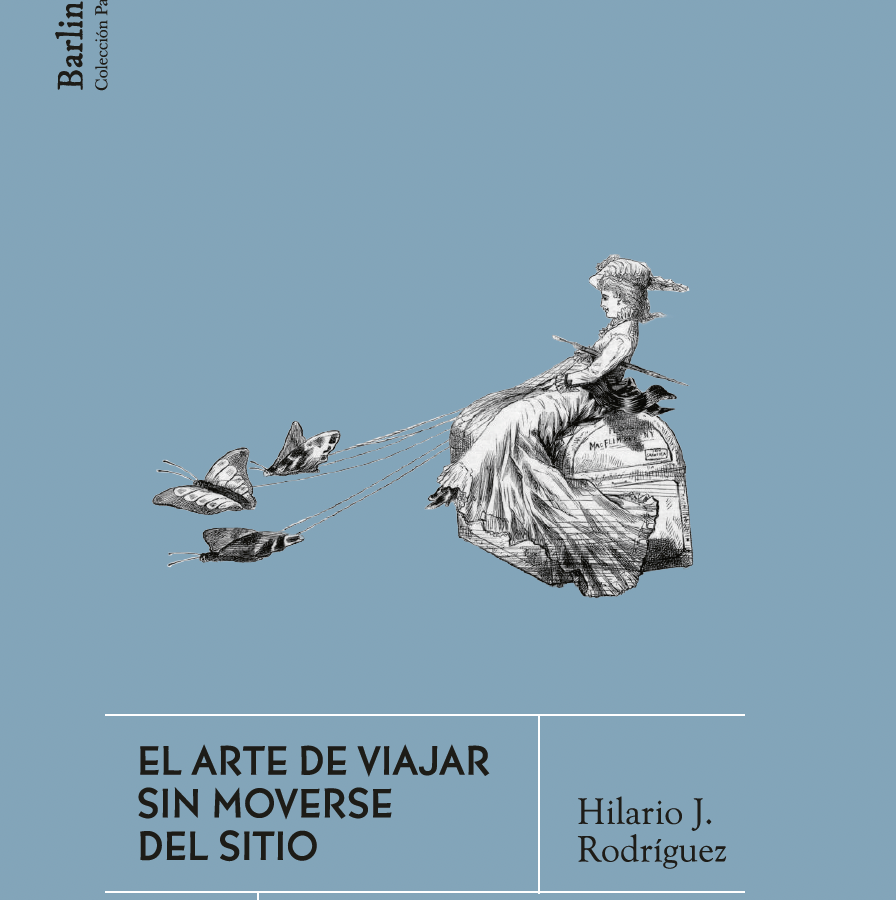
The Art of Traveling Without Moving from One’s Place deals with the contradiction of wanting to be a nomad and a writer at once. Walking is a task that contributes greatly to creativity, but to put something on paper in black and white you must stop. There is also the option of reading geography, as Hilario J. Rodríguez does, who understands this science in a very holistic way: in his worldview, geography is volatile, moves at whim, and, in turn, encompasses any other form of knowledge. The world is the world and at the same time its representation. That allows the essay to be sprinkled with anecdotes and moments, stories that enrich the longing of those who see themselves as travelers, as a refuge for that spirit that must be pursued with zeal to uncover its last remnants.
As a caveat, one might think that the footnotes, as interesting as the main text, interrupt the reading somewhat and that one would have liked these texts integrated. But that is a minor problem in an essay of this nature, in which there are few occasions where references to personal experience assert themselves, for fear of slipping into some neocolonial interpretation, and what prevails is that resource to combat the nostalgia that desire can provoke, and which is none other than the benefit of imagination.
—————————————
Author: Hilario J. Rodríguez. Title: The Art of Traveling Without Moving from One’s Place Publisher: Barlin. Where to buy: Todos tus libros.