
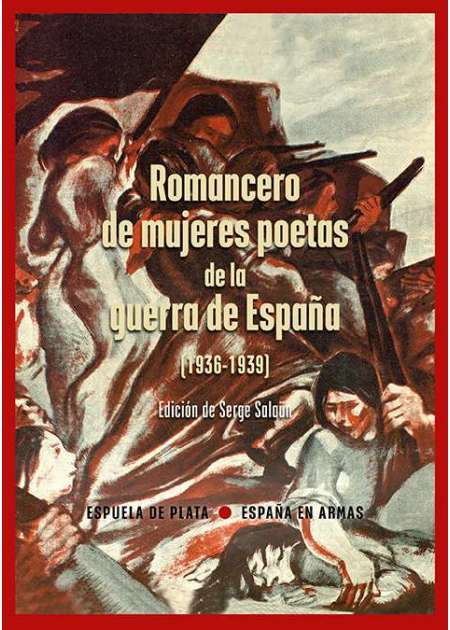
Although extensive research, study, writing, and anthologizing have been directed at verse—and, in many cases, poetry—produced during the war that broke out on July 18, 1936 in Spain, a vast portion of the works from that era still awaits exploration, especially those created by women. This reality has been brought to light by the French Hispanist Serge Salaün, an indisputable expert on the subject and author of one of the indispensable books in Civil War scholarship, The Poetry of the Spanish War. Currently emeritus professor of Contemporary Spanish Literature at Sorbonne Nouvelle-Paris III, this philologist has given us a broad selection of texts by female authors that were versified during the more than three years of that political and armed conflict. The selection represents only a part, albeit a substantial one, of the countless works of that kind that have been lost for various reasons, and we fear that this loss may well be irremediable.
The compilation of pieces gathered by the editor, a Frenchman, predominantly stems from the Republican camp, not from the so-called National faction that rose up against the established power. That National side, demonstrably, was far less significant in terms of poetry composed by women during that period. Yet such works did exist, and among them two names stand out for readers worldwide. I refer to the Madrid-born poet and playwright Pilar de Valderrama, who was lyrically renamed Guiomar by Antonio Machado, and the Gran Canaria-born Josefina de la Torre, a multifaceted woman who, in several respects, shares ties with the Generación del 27; two poets who had the support of others in earlier years, Pedro Salinas penning the preface to her first book, Versos y estampas in 1927, and Gerardo Diego promoting her by including her in his anthology Poesía española contemporánea (1901-1934).
As an anthology, and as the editor notes, texts that stitched together slogans and topical turns of phrase from the era in an automatic fashion did not find a place among the hundred verse-pieces gathered here, a sensible and reasonable choice on many counts. The volume that results from that curation forms a corpus in which the texts—written by increasingly confident female authors—are reproduced in alphabetical order by author, with some pieces written anonymously, under a pseudonym, or merely by first name, and thus often difficult to identify. Others, however, were already establishing themselves in the literary world. The names include Concha Méndez, Ernestina de Champourcin, Carmen Conde, Lucía Sánchez Saornil, Susana March, Ana Matía Martínez Sagi, and the aforementioned Rosa Chacel.
In the volume, Spanish women such as those mentioned and many others are represented, though to a lesser extent women from various Spanish-speaking American countries who felt deeply moved by those brutal events and their political readings. Among them one finds the renowned Uruguayan poet Juana de Ibarbourou, who has Galician roots, and the versatile Argentine journalist María Luisa Carnelli, war correspondent in Spain for the Buenos Aires magazine Ahora. A particularly atypical case is the Chile-born-but-Argentina-based writer Concha Zardoya, who, through her deep ties and growth both personally and literarily in Spain, should be regarded predominantly as a Spanish writer, though she was born in Chile.
Regarding the makeup of the works, the compiler notes that, for the most part, they do not present a radical feminist perspective, though, of course, the defense of free love is not lacking, mainly among authors with anarchist ideology, with a few even openly proclaiming lesbianism, as in the cases of Lucía Sánchez Saornil and Ana María Martínez Sagi. It is also noteworthy that “the image of the armed and heroic miliciana never appears,” a fact probably limited to the covers of some more sensationalist magazines. This does not prevent certain texts from praising women who undertook heroic actions and who would die as victims of the war.
Nevertheless, it is worth emphasizing a fact that, in my view, goes beyond mere curiosity and may be weighed at other interpretive levels, perhaps ideological alignment: these women do not usually align with those celebrated by many male poets, some of them highly celebrated. In contrast, in the Madrid periodical Mujeres Libres, which served as the organ of the CNT-FAI’s Mujeres Libres organization, Lucía Sánchez Saornil lauded in its fifth issue the memory of a libertarian, María Silva Cruz, in her “Romance of the Libertarian Woman”, and in its ninth issue Encarnación Jiménez in her “Romance of Life, Passion and Death of the Guadalmedina Washerwoman”. I do find concurrence between them and the male poets in the tributes to Federico García Lorca, to whom several homages are dedicated, always involving recognizable intertexts drawn from Lorca’s celebrated passages. And the practice of dedicating texts to the mothers of the soldiers would not be sporadic in the anthology, as we intuited, marking another distinctive feature of these writings when compared with the works produced during the Civil War by male authors, where the figure of the mother does appear, albeit with a very different emphasis from that found in the verses of many women.
In substantial, well-developed epigraphs, Serge Salaün contrasts two notably opposing poetics: those of anarchist women and those who published chiefly in a magazine with a clearly intellectual bent, Hora de España, mentioned above. While the editor concedes that anarchism does not seem to have had its own distinct aesthetic, he notes that their verse—in the eyes of libertarian thinkers of the time, when compared to prose—relies on realism, is highly conventional, avoids symbolic devices, and rejects both daring stylistics and nonconformist writing positions.
For the authors who were “professionalized” in literature as an institution within society, Serge Salaün observes that they progressively reduced the use of romancero patterns that had given such play to the pages of the magazine El Mono Azul, where female presence was, to put it mildly, minimal. They largely preferred to publish their texts in Hora de España. It is worth noting that this monthly magazine, first published in Valencia in January 1937, generally reflected its basic aesthetic in the content of the collective address read by Arturo Serrano Plaja at the II International Congress of Antifascist Writers, a text that the magazine published in its August issue of that year. In that address, both realism and pure art, the abstract, and the propagandistic temptation were rejected, with the signatories arguing for the exercise of personal creative freedom.
Bajo el sol que aún no quema sigue tu cuerpo erguido,
y en tus manos heladas una visión de siglos
palpita ya hecha carne. ¡Sobre el mundo en peligro
se convierte en aurora la noche que has vencido! (135)
———————
Autor: VV.AA. Título: Romancero de mujeres poetas de la guerra de España (1936-1939). Editorial: Renacimiento. Venta: Todostuslibros.