
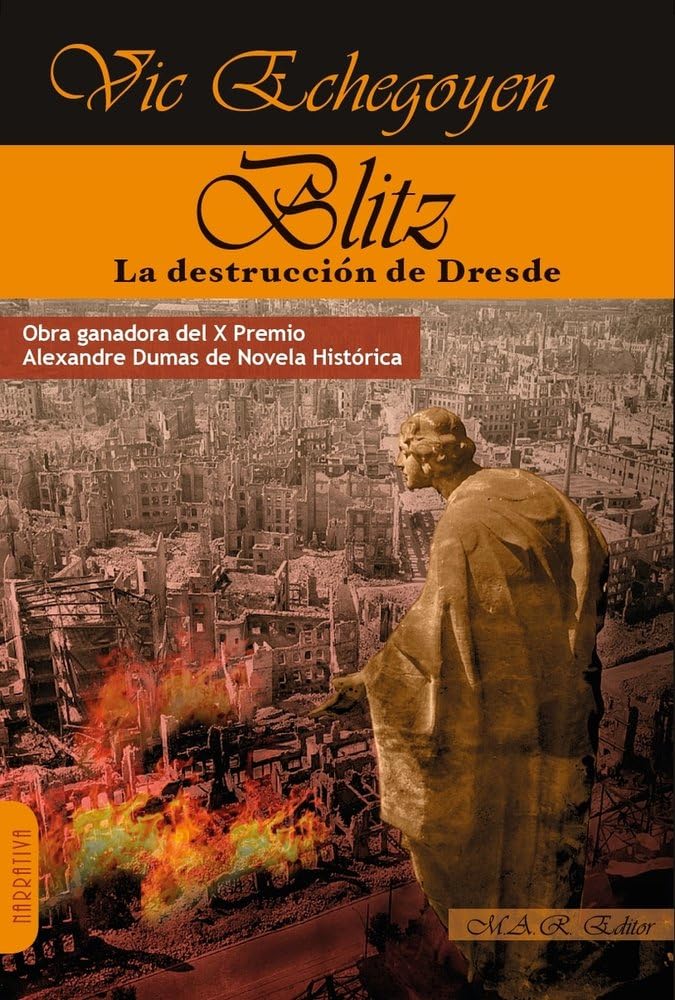
The writer Vic Echegoyen returns to the grand historical novel with Blitz (M.A.R. editor), an ambitious literary reconstruction of one of the most devastating nights of World War II: the Allied bombing of Dresden in February 1945. But those who expect only a war novel are mistaken. Echegoyen uses that catastrophe to raise questions that are far more uncomfortable and relevant today: how a society is rebuilt after hatred, what remains of humanity when everything collapses, and to what extent forgiveness between irreconcilable enemies is possible.
From Hungary, where she has lived and worked for years, the author explains how a story that had accompanied her for decades eventually became a novel that speaks directly to today’s Europe and to wars as close as Ukraine.
*****
—We all know what the Blitz was, the bombings of cities during World War II. But what exactly is Blitz? What will readers find in this novel?
—You will find a story of war, of destruction, of death and horror, but also a story of hope. I wanted to tell a dreadful episode of European history that, however, ends in something luminous. It may seem like a contradiction, but it isn’t. The extraordinary thing is that that happy ending really existed. When we think of Dresden, we think of fire, ruins, thousands of deaths and a city erased from the map. All of that is in the novel. But there is also what came after. How people who had been mortal enemies were able to shake hands and build something new. For me, that is the true story.
—When did the novel begin to take shape?
—Much earlier than the first line was written. I had carried it inside me for decades. One of the real protagonists survived the Dresden bombing and went on to become the nanny of my mother and uncle. I grew up listening to her memories. That woman did not speak of history. She spoke of what she had seen, smelled, endured. She spoke of people. For years I wanted to write that story, but I knew I wasn’t ready. It was necessary to find the right distance and, above all, the correct approach. I did not want to write simply a novel about a bombing. That already existed.
—What did you finally find?
—Reconciliation. When I discovered that many of the British and American pilots who took part in those attacks returned years later to Dresden to help rebuild the city and to ask for forgiveness, I understood that there lay the heart of the novel. We’re talking about young men of eighteen or nineteen. Boys practically still teenagers who had participated in one of the war’s most devastating operations. When they saw the real consequences of what they had done, many decided to return. I found that extraordinary. And I still find it extraordinary today.
—Does Ukraine’s war have anything to do with the decision to write it now?
—Very much so. I live in Hungary, a country that borders Ukraine. Since the war began I have seen hundreds of thousands of refugees arrive. Entire families. Elderly people. Mothers with small children. People who have lost absolutely everything. That stirred many family memories. My mother, my uncles, my grandparents were also war refugees. They always told how they were welcomed by people who had almost nothing for themselves and yet shared the little they had. When I saw those scenes repeating themselves eighty years later, I felt the story telling me that it was time to write Blitz.
—What has been the hardest part of this book?
—Understanding how ordinary people manage to keep their humanity when everything around them is collapsing. That is the hardest, and also the most beautiful, aspect of the novel. The protagonists are afraid. They make mistakes. They suffer. But they keep helping others. They risk their lives for neighbors, for strangers, for prisoners of war. Even for animals trapped in the zoo. Because that is another of the stories that appear in the book. The fate of the Dresden zoo animals during the bombing. And all of that happened in reality.
—The novel has a very cinematic structure. The reader is in many places at once.
—Yes. It is a technique I already used in Resurrecta, the novel about the Lisbon earthquake. There are events so large that they cannot be told from a single point of view. You need to see them from inside and from outside at the same time. That’s why the reader can be in a church, in the circus, in the museum, in the zoo, in the ghetto where the last Jews await deportation the next day, and, simultaneously, inside the bombers approaching the city. I wanted the reader to feel as if they were living that night minute by minute.
—How do you build such a complex ensemble novel?
—By listening a lot. Documentation is essential, but there comes a moment when the characters themselves begin to show you the path. I have visited Dresden many times. I have worked in archives. I have interviewed survivors. I have spoken with people who are over a hundred years old and retain prodigious memories. They all agreed on one thing: that night continues to live inside them.
—Many characters seem too extraordinary to be merely invented.
—Because in many cases they actually existed. There is a half-Jewish dancer pursued by the Nazi regime. There are censored painters. There are musicians, scientists, museum curators, zoo keepers. One survivor told me he saw a painter daily drawing lions in the zoo because the Nazis had prohibited him from displaying his work. Stories like that sound invented, but they are real.
—Reading the novel gives the impression of a chronicle more than fiction.
—That was precisely my aim. Of course there is craft. There is narrative structure. There is reconstruction. But I tried to make the reader feel they were witnessing something true. Because it is true. The remarkable thing is that no one had gathered all those stories into a single narrative before.
—Why do you think we keep reading war novels?
—Because war is an extreme laboratory of the human condition. From the Iliad to today, great epics originate in conflict. War concentrates in a matter of hours or days everything that normally remains hidden: cowardice, heroism, compassion, cruelty, sacrifice. All readers ask themselves the same question while reading: “What would I have done?” And no one really knows the answer.
—What can a novel offer that documentaries, newspapers, or social media cannot?
—Time. Literature allows you to pause. You can close the book and think. You can go back. You can reflect. You can digest what you’ve just read. Social networks force you to consume tragedies at a relentless pace. One war follows another. One catastrophe follows the next. Literature does not work like that. Literature compels you to coexist with the people.
—In Blitz the question of forgiveness appears constantly.
—Because without forgiveness Europe would not exist. And that doesn’t mean forgetting. It means understanding. I have lived many years in Germany. Also in Eastern Europe. I have known families marked by Nazism, by communism, by deportations, prisons, and persecutions. If every generation inherited all the hatreds of the previous one, Europe would be uninhabitable.
—Do you believe in a hereditary historical guilt?
—No. Historical responsibilities exist. But guilt cannot be transmitted forever from parents to children. Today’s German youth are not to blame for Auschwitz. Today’s Russian youth are not to blame for Stalin. And today’s Spanish youth are not to blame for the Civil War. What matters is knowing history and learning from it.
—What is the final message of Blitz then?
—That only people save people. Not governments. Not ideologies. Not speeches. People. That is what I saw in Dresden’s testimonies. That is what I have seen in Ukraine. And that is what we continue to witness whenever a society faces a crisis. In the end, when everything collapses, there is always someone willing to help another human being. And that is perhaps the sole reason we continue to hold on to hope.