
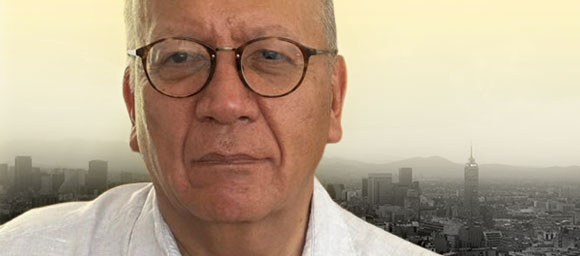
They say that on the night the poet Vicente Quirarte passed away, a bat was seen gliding through the streets of Mexico City, surveying his vast literary heritage and granting the city he deeply loved a new set of wings. As recalled by his friend and pupil Roberto Coria, Quirarte wore so many facets that the Mexican cultural scene has been left stunned by the sad news of his death, just after he turned 72 on July 19: a generous friend, a marvelous host, a storyteller, a poet, an essayist, an academic, a nineteenth-century scholar, a cinephile, a playwright, a traveler, a devotee of Mexico City, a bon vivant, a gourmet, a joker, a lover, an organizer of courses, diplomas, cinema cycles, a circle called Cadáver Exquisito, the late Casa Poe, Horror Literature Conferences at the Minería Book Fair… His literary oeuvre, spanning multiple genres, positioned him as a key figure for understanding contemporary Mexican literature and its links to history, memory, and the city. In his career, Quirarte did not separate literary creation from critical thinking, exploring the Mexican tradition, the connections between literature and history, and Mexico City as a living stage of cultural memory. His literary journey began in 1979 with the poetry collection Teatro sobre el viento amado, a work recognized with UNAM’s Punto de Partida prize. Among his books stand out Vencer a la blancura, El azogue y la granada: Gilberto Owen en su discurso amoroso, El ángel es vampiro, Razones del samurái, Ciudad de seda, La miel de los felices, Sintaxis del vampiro, La invencible or Merecer un libro, works in which he pursued a dialogue between poetry, memory, death, the city, and the Mexican literary tradition. He himself captured part of his intellectual ethic with a line that will always hold meaning: “The secret is not to be young, but to keep youth, the restlessness before the idea that does not prosper, the phrase poorly articulated, the project superior to thought.” Another death to lament is that of Ediciones Era, one of the most influential labels on the Spanish-language publishing scene, which has just announced the cessation of its commercial and editorial activities due to financial troubles. In a statement from its editors describing the pause in operations, they explain that the publishing house will close out accounts with all bookstores and distribution points carrying their books. “Today, 66 years after the publication of the first book of Ediciones Era,” they note in this message that sends a shiver, “we find ourselves compelled to admit that the book market has changed so much that we can no longer live off the sales of our books. The network of bookstores that existed before the pandemic and that guaranteed our subsistence disappeared, to the extent that sales fell to merely 25 percent of what they were before. Over these last six years we have fought in a thousand ways to keep the publisher alive, but the revenues needed have not arrived. With much effort we settled several debts incurred during the pandemic, but the amounts we owe only continue to grow. We sold the Era house in the Roma neighborhood and, thanks to that, today we are in a position to make some payments and to halt the publisher’s operations to avoid falling into unpayable debt. We thank you for all the years of collaboration. The space given to our books and the interest in our imprint, our authors, and our themes over the decades. It has been a privilege to have you help disseminate Ediciones Era’s books.” The Mexican imprint, founded by Neus Espresate, Vicente Rojo and José Azorín, and led by Marcelo Uribe since 1991, published novels, poetry, short stories, journalism, history, social sciences, art, and children’s and youth books, and today its catalog comprises more than 500 titles, including unquestionable masterpieces by authors such as Juan Rulfo, Carlos Fuentes, José Emilio Pacheco, Octavio Paz, Elena Poniatowska or Carlos Monsiváis, to mention a few. The closure of this publisher reveals how fragile cultural enterprises are in Mexico and serves as a warning of what might still lie ahead.