

I’m not what you would call a gamer, but I was one. I was one as a child. When my mind was developing. Back then, the arcade machines in bars were a luxury I could scarce afford, and that’s why they lodged themselves in me for life. They were a coveted object that, even today, remains inside me as a lasting desire.
Entertainment on my computer
However, when personal computers arrived, a golden era of video games began in my life. I enjoyed an Amstrad CPC 6128 with a floppy disk drive, which allowed me to load them much faster than my friends with cassette tapes, and the “chirp” that followed the LOAD “” command that transferred data from tape into the personal computer’s memory.
Back then, games weren’t easy. No tutorials. No continuing the game where you left off. No explaining how to kill the monster or giving you endless chances to beat The Abbey of Crime. If you didn’t do what you were supposed to in time, you were screwed. It wasn’t a time to cry.
Beating the games of that era was very challenging, and I developed a lot of frustration tolerance with games like Dr. Livingstone, The Abbey of Crime, Game Over or Manic Miner, where you had to know the puzzles one after another. All those games forced me to think, reason, and discover how to solve each “screen” and to memorize them intellectually and physically. In those beginnings, levels were “screens.”
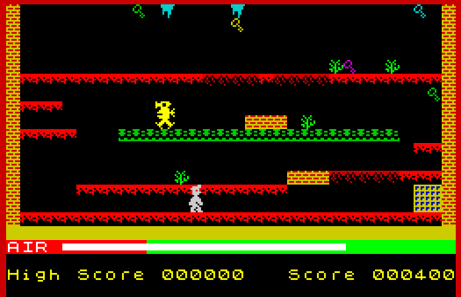
Play online Manic Miner and tell me if it’s easy.
Afterwards I played a lot, a lot, a lot. Many hours. I could enumerate the complete game list, but there were many: Commandos, Rastan Saga, Ghosts ’n Goblins, R-type, Kung-Fu Masters —the stick-wielder—, Ikari Warriors, 1942, Freddy Hardest —what a cool guy!—, Renegade —which I loved—, Rampage, Bombjack, Prince of Persia —wonderful—, and an endless list. I played on my Amstrad CPC 6128, I played on my PC 486 DX2 with a graphics accelerator card —I already had a GPU back then—, and I never stopped playing until I started working.
In that early period, games were entertainment that required intellectual ability and technical dexterity to solve. For me they were the simplest games designed for Z80 hardware, the ones from Spectrum, Amstrad… but then two more phases would come. The era of the AMIGA 500 with my friends and graphic adventures, and the era of my Pentium 100 MHz with strategy games… Both were brutal.
From playing to living adventures in first person
In the phase of graphic adventure games, we used to gather at my friend Juancar’s house, a group of friends that we still stay close with—Gustavo, David “Rabo” (don’t ask), Molallan, and others like that—enjoying the wonderful graphics of the Amiga to live the most entertaining graphic adventures we’ve ever had. Loom, Maniac Mansion, The Day of the Tentacle, Indiana Jones and the Last Crusade, Indiana Jones and the Fate of Atlantis and, of course, the complete Monkey Island saga.
Solving the adventures would take days and weeks of collaborative work. We laughed again and again at the antics of Guybrush Threepwood, and his verbal duels: “Look behind you! A three-headed monkey!”, and we still cry whenever we remember them. Of course, when we meet someone who talks a lot we say… “Damn, look, Stan S. Stanman,” the one you had to ask to teach you how to open the coffins and stuff them inside…
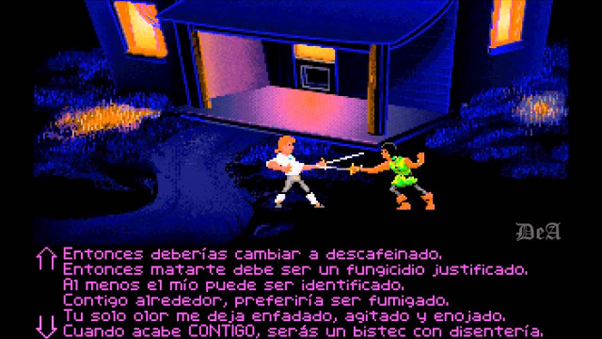
“Yo soy cola, tú pegamento”
The music of Monkey Island became iconic, just like the movie soundtracks, and although I finished Monkey Island 1 and 2 many times, I would play it again, even though I admit I know almost all the levels by heart, and Guybrush Threepwood is like a friend. For those who don’t know where the name Guybrush comes from, it’s simply because the file name where I saved him was Guy.brush (Guy, “guy”) and .brush (bitmap file format for the character’s design). I love it.
I could tell you a thousand anecdotes that are part of my life regarding those years of graphic adventures that were so important in my formation as a person, and that have remained as a cultural backdrop of references, music, and anecdotes in my life forever.
The strategy game for life
But from there came the era of strategy games and my mind exploded. I remember first playing Warcraft and discovering with fear and excitement the world map. It was the first time I played that kind of game, and it drove me crazy. You had to organize production, you had to invest resources correctly, and you had to make bold attack decisions while you prepared for the worst. You always had to consider the most dangerous hypothesis.
The pinnacle of that era for me was Age of Empires, which shattered my assumptions about what it meant to play such a game for good. I spent hours, and I learned that “picking rocks” and sacrificing yourself to gather resources was better than rushing in recklessly. What a beautiful metaphor for life.
The truth is those games were different. The world was complex and you had to deal with the intelligence that managed that complexity. I also played, along those same lines but with radically different concepts, Commandos, where you had to complete missions with strategy and resource coordination, or the famed PC Football Manager, where you managed football clubs as if they were businesses. A marvelous lesson for my entrepreneurial life later on.
I became hooked on those games, along with the Theme Park, Theme Hospital family, and anything with a whiff of strategy. I always preferred complex games where you had to organize resources, plan courses of action, make reasoned decisions with long-term plans that you had to follow to the letter. You had to be patient. You had to strengthen your resources to take the next step. I needed to grow stronger first. You had to control impulse, emotions, bottle up impatience and keep working. Strengthen your team, your civilization, your army, your company.
Video games as a narrative medium
Of course, I also played shooters, but not a lot. Sports, Doom, or the marvelous Quake II were part of my late adolescence and my first steps into adulthood. And one day, without realizing it, I kept playing, but they were no longer just a screen and a separate virtual world. It was real life. It was my company. But in my head it still felt like a turn in Age of Empires. I had to hire employees, manage revenues, pay expenses, run operations… and play.
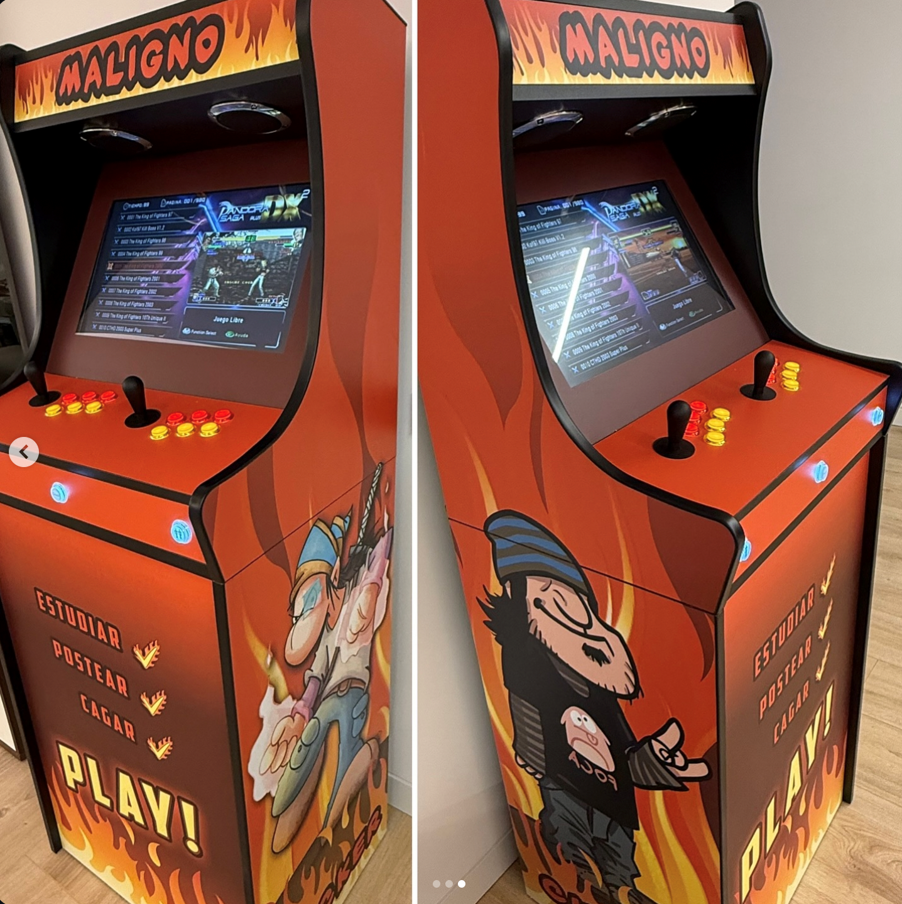
My customized Arcade machine
Thirty years later, I still like to play in life. And although I haven’t gotten hooked on the megajuegos of today, I’ll confess two things. First, I own an arcade machine with emulators for all the arcade games I couldn’t afford as a child. Normal. Childhood traumas always surface eventually. And secondly, and this is even better: I love watching game-plays of films that extend the storytelling through games.
For example, recently in Lisbon I revisited many complete character-driven film series. Alien, Hellboy, Spiderman, Terminator… To do this, I make a chronological list of films and TV series, and I watch them one by one. And the story leads to the film adaptations of the games. For example, Alien you can’t claim to know the full story if you haven’t seen “Alien: Isolation,” the full-game movie.
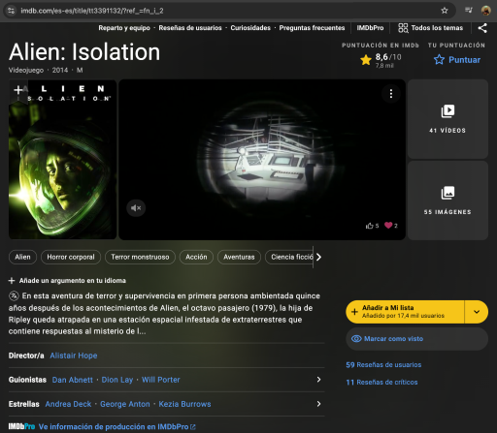
Alien Isolation video game on IMDb 2014.
In 2019 it became a series that you can also see documented on IMDb. And in 2027, the second installment, Isolation 2, is released. If you don’t like video games, you’re missing a lot of story.
To show you how this world of stories works for me, the iconic film TRON, which greatly influenced my life decisions, is a story that unfolds across books, comics, series, video games, and Hollywood movies. I arrange them all, buy the comics and the books, and then watch them all in order. Then I share this documentation on my blog: TRON: The story through the films, series, video games, and comics.
To me, comics, series, films, books, and video games are nothing more than different formats, each with its own advantages for telling a part of the story by taking full advantage of the medium’s capabilities. And video games offer narrators unique abilities to immerse the viewer in the story in first person.