
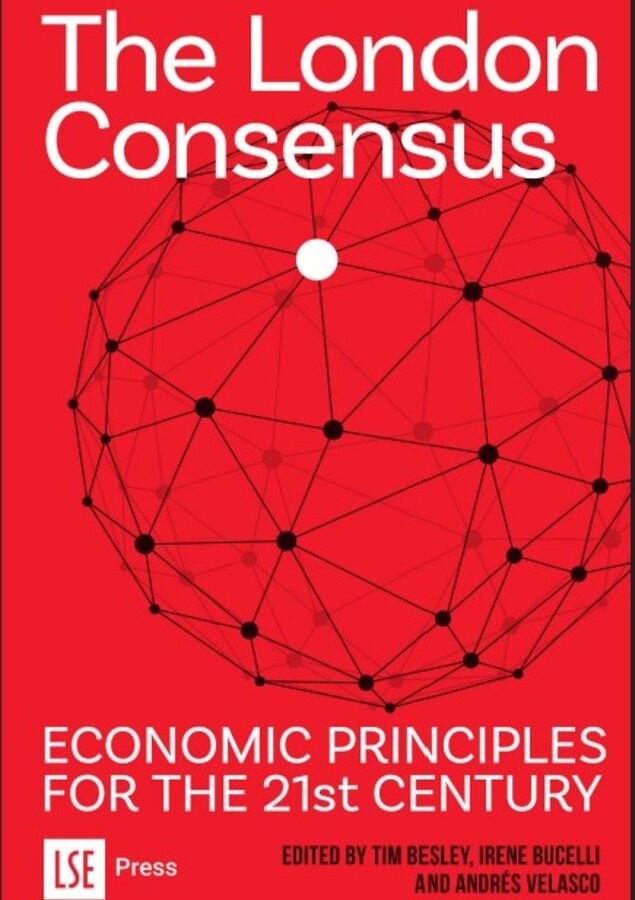
The introduction of the book opens with a clear warning: the future is conditioned by globalization, technological development, climate change, populism, and polarization. In light of this scenario, the risk grows that politics itself becomes the main driver of economic crises.
To address this scenario, a collective project brings together in London more than 50 economists and finance experts from around the world in order to decipher the complex mechanisms of the international economy. Through a selection of essays, the volume weaves a strategy of resistance against massive privatizations, while questioning the privileges and power structures of traditional capitalism.
The London Consensus: Economic Principles for the 21st Century (LSE Press, 2026; edited in the United Kingdom and still not translated into Spanish) confronts the tensions that arise in the pursuit of equity. The authors of this collective analysis pose deep questions about an economic order to decipher, offering more questions than absolute answers.
The work commemorates the 35th anniversary of the “Washington Consensus,” proposed by British economist John Williamson (1937-2021). The book acknowledges the limitations of that model, noting that it “left aside social and institutional factors indispensable for achieving sustained growth and building fairer societies.” In response, the authors propose updated principles for the 21st century based on economic pragmatism.
This academic debate, born on the banks of the Thames, seeks to generate realistic guidelines for inclusive growth, productivity, innovation, and social cohesion. Edited by London School of Economics academics Tim Besley, Irene Bucelli, and Andrés Velasco, the text “does not aim to be a set of universal economic remedies, but a compilation of the best available evidence and ideas.”
The analysis focuses primarily on labor markets and strategies for social equity. Dani Rodrik, Turkish-American professor at Harvard University, explains that the model “prioritizes the diffusion of productive economic opportunities across all segments of the workforce” in order to improve overall well-being.
In a global environment obsessed with individual narratives, this compendium denounces the failures of hyper-globalization, the rise of populism, the climate crisis, the impact of artificial intelligence, and geopolitical fragmentation. Rodrik warns that “technological trends and globalization are hollowing out the center of the labor market,” thus urging a transformation of production methods and the democratization of decision-making.
In this way, public governance and international relations are linked to mitigate the environmental crisis through the state’s capacity. Anne-Marie Slaughter, American political scientist and lawyer, argues that the fundamental premise is to understand that “well-being is the key, not just money.” The work thus defends a common stance that revalues public institutions without idolizing them.
Finally, the volume emphasizes that public finances must prioritize human well-being over mere market efficiency. To this end, it rescues Ioana Marinescu’s pragmatic supply-side progressivism, a professor at the University of Pennsylvania, which advocates for dignified jobs, strong competition laws, and resilience in the face of AI. Far from being a monolithic manual, this “London Consensus” is presented as a space for dialogue to promote sustainability and shared stability.
—————————————
Authors: Tim Besley, Irene Bucelli and Andrés Velasco (eds.) Title: The London Consensus: Economic Principles for the 21st Century Publisher: LSE Press.