
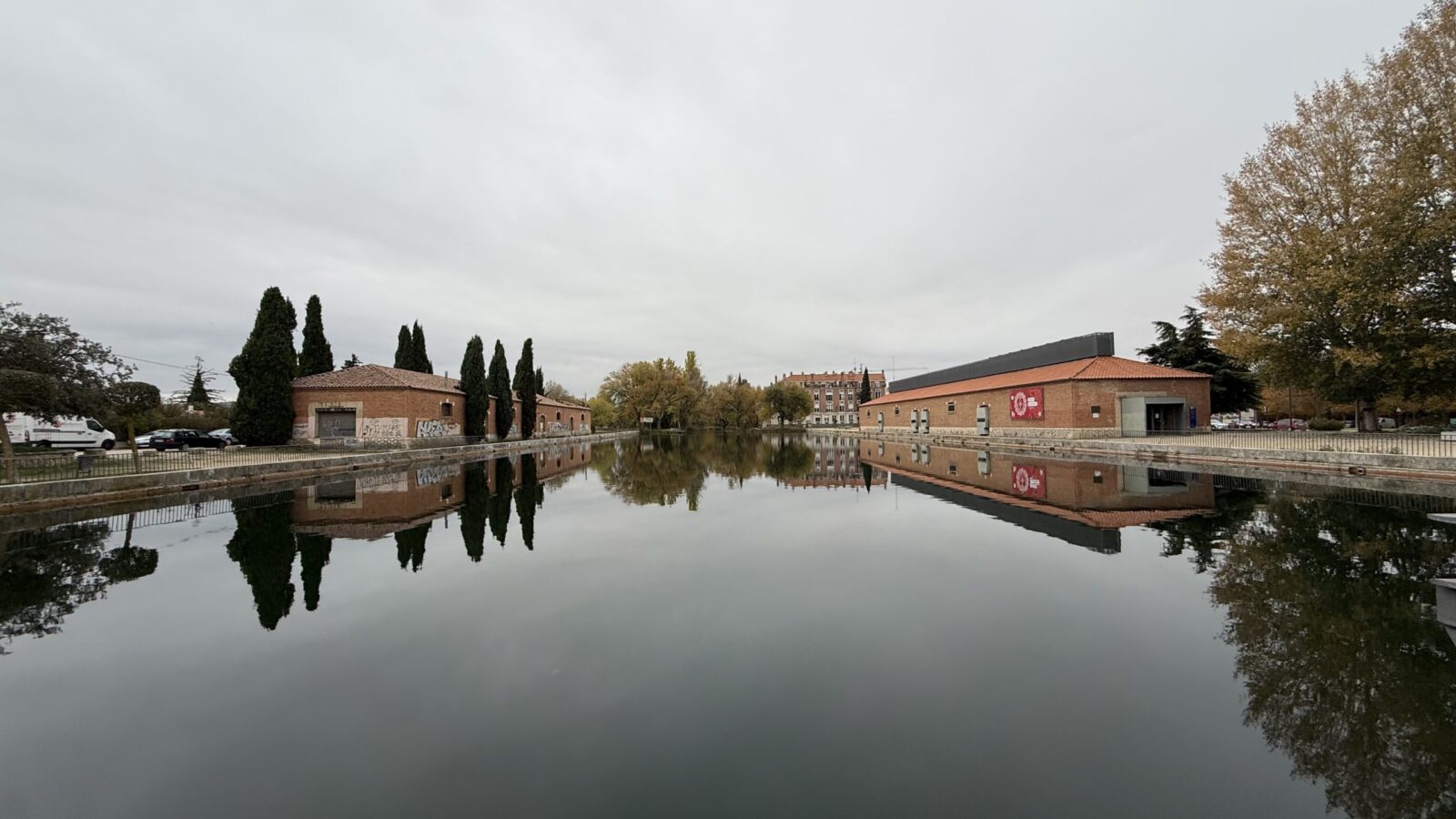
Every now and then one manages to strike places whose boundaries seem designed for time to drift gently through them. The Canal de Castilla, at least each time I’ve come across it, appears to be one of those. Just step close to either bank and contemplate the calm of its waters, and hear the murmur of the trees that sway their branches around, to confirm that there the clock hands move at a different pace. I won’t fall into the temptation of writing that hours stop, but the world does indeed turn at another speed, with a deliberation that we might think forgotten. The current flows unhurried between the towpaths and carries on its surface the shadow of the poplars, a leaf that has fallen now that autumn has reached its apex, the reflection of some clouds that perhaps will not form part of the sky when they finally reach their destination. There is something radically Castilian in that way of anchoring to the landscape. Castile has been described to the point of dullness as a dry, rough, unbearably horizontal land, made up of endless fields and peppered with towns that seem abandoned to their fate. It is not a notion devoid of foundation, but nor does it fit a geography much more complex than these simplifications allow. In the province of Palencia, where the northern peaks finally yield to the endless plains of the Tierra de Campos, water has written one of the most beautiful pages in the history of that land; and it has done so, curiously, by the will of men.
The Canal de Castilla was born from a beautiful Enlightenment dream. In the mid-eighteenth century, when the ministers of Fernando VI were seeking, almost in despair, remedies to ease the country’s economic lag, the marqués de la Ensenada imagined an extensive network of navigable canals that would allow transporting Castilian cereals to the ports of the Cantabrian Sea. Antonio de Ulloa took on shaping that project from the works of the military engineer Carlos Lemaur, and around 1753 the first works began in Calahorra de Ribas. They intended that intellect, calculations, and effort would correct what nature had determined with irrevocable certainty: to bring water where there was none, to make navigable a land that lacked sea. It was a plainly overambitious undertaking that took nearly a century to complete. When the works were finished —the calendars marked the year 1849—, the world had changed so much that the arrival of the railway signaled the obsolescence of what at that moment had constituted a prodigious innovation. In one of those ironies that were sporadic then and now occur more and more often, progress buried a novelty that had barely just debuted. It would be unfair, however, to declare that the Canal was a total failure. For decades it transported goods and fed mills and flour factories; it also gave work to hundreds of people, and forever transformed the appearance of the places along its route.
Its route runs through three branches and totals two hundred seven kilometers, and a large portion of its beauty is concentrated in the Palencia lands. In Alar del Rey the waters of the Pisuerga feed the Ramal Norte, opening a journey that carries something of an expedition through a kind of secret Castile. Along the way appear Herrera de Pisuerga, Osorno, Frómista or Ribas de Campos, names that carry an ancient density and demand a slow pronunciation, as if each one holds a history that merits attention before moving on. The towpaths over which horses once dragged the barges allow walking today along the canal with no company but birds and wind. On one side lie the fields, and on the other a row of trees accompanies the course of a river that is not really a river. In Frómista lies the Canal de Castilla, born from the enlightened faith in reason and progress, together with the Camino de Santiago, which for centuries has aimed to guide pilgrims to the tomb of an apostle, giving rise to one of the most picturesque crossroads in Spanish geography. Not far from the Romanesque church of San Martín, four consecutive locks overcome a drop of more than fourteen meters, and there is a rare beauty in the austere severity of those stone constructions, in their millimetric geometry, also in the way the water folds obedient to the instructions imposed by a mechanism conceived more than two hundred years ago. Farther south, in Calahorra de Ribas, the memory of the first steps of that grand venture is preserved. There the Canal and the Carrión are joined at the foot of three more monumental locks, and one, while watching them, imagines the engineers who prepared the ground, who calculated the slope of the gradients, who tried to persuade their peers that that enterprise was plausible, and also those who labored to excavate the earth, place the stones, and raise the bridges. It is a rightful act, because history usually remembers with great detail those who conceive and sketch projects, but rarely takes into account the hands that proved indispensable to bring them to life. The Canal splits at El Serrón and one of its branches heads toward Villaumbrales, where the old Casa del Rey bears witness to the times when shipyards existed in the heart of Castile, while the other heads toward the city of Palencia, where the dock and the old warehouses once buzzed with activity that today is hard to evoke. Certainly, there was a time when these shores were populated with boats and the bustle of cargoes, animals, and men could be heard here, but what now prevails is silence, and perhaps that transformation, that alchemy that turns an old infrastructure into a landscape of memory, is what gives the Canal its unexpected melancholy.
Perhaps Azorín would have known how to linger on the details—a rusted gate, the worn stone of a bridge, the window of a lockkeeper’s house—to find in them the persistence of a Spain that changes but never quite ceases to exist. This is how it is with the Canal de Castilla. It is one of those places where you do not need to reconstruct the past because, at first glance, you can see that it remains, incorporated into the everyday life of things. Hence the best thing is to travel it without a purpose, walk beside its waters and sit to rest beneath the trees and observe the silent movement of the current; to think of those who passed by it before, of the barges that no longer exist, and of the voices that have ceased to be heard. In this way one understands that that old aspiration to connect Castilla with the world has culminated in a form of beauty, something its promoters could hardly have foreseen. The Canal keeps advancing, unmoved, across the Palencia plain, with an absolute indifference to the haste of our era. The waters pass, the trees age, the seasons succeed. Everything changes; and yet, there is something that remains.