
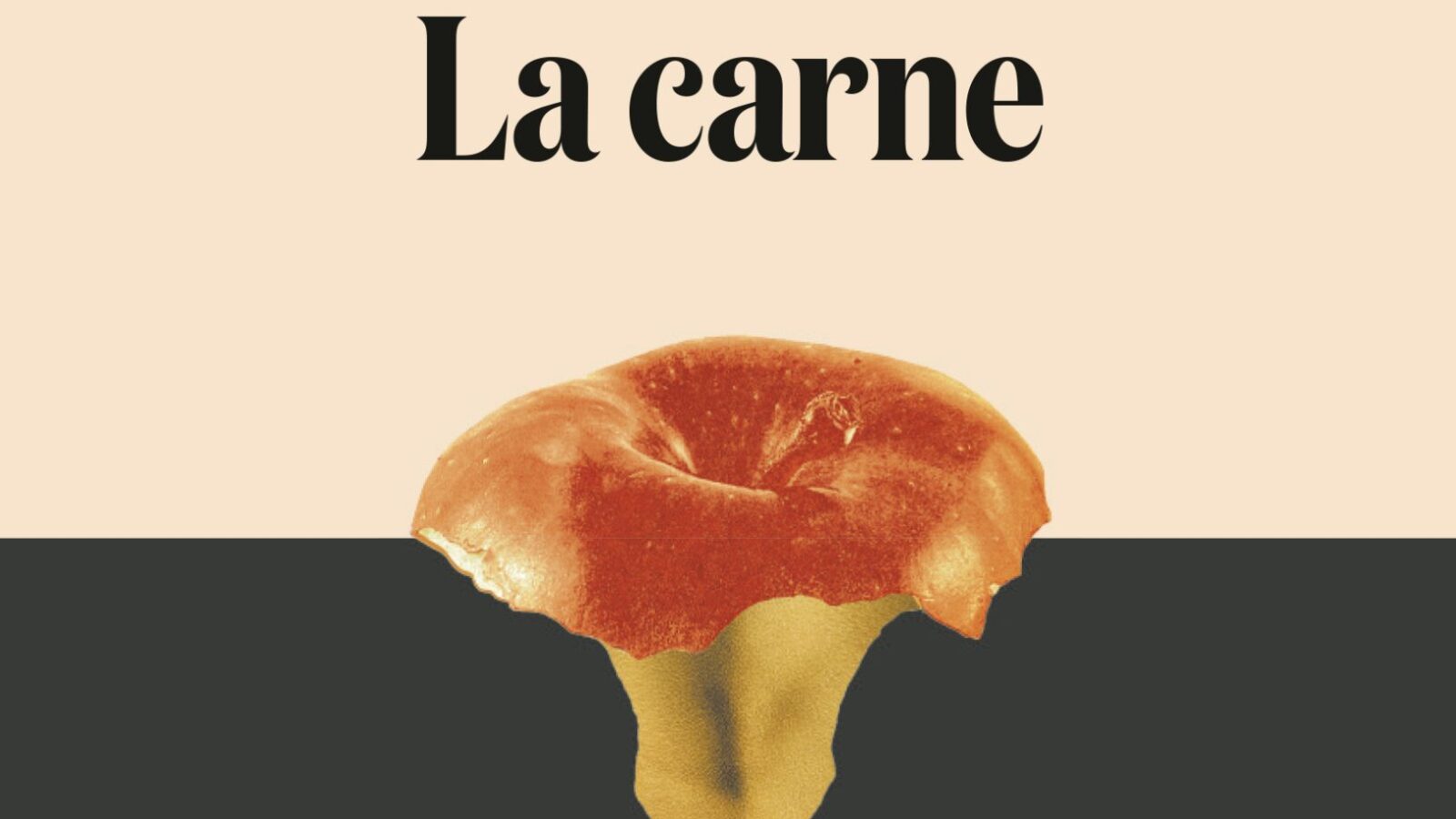
A body fibrous with its own pulsations, of whom we know nothing except its certain decomposition. A body of blood and flesh, of water and flesh, of silences condensed into being flesh and in which only the contemplation of the other fits. «I go the way of all the earth; be strong, therefore, and show yourself a man» (1 Kings 2:2). Those were among the final words of King David to his son Solomon, with which, beyond pointing him to a common destiny, death, he accepted that every human being is and will always be flesh that thinks. To its needs and imperatives yield intention, and more so our scruples in the face of violence. The flesh moves and defines spaces, regardless of how devastating the consequences of a gesture may be, of the frictions involved with the mass consumption of pain or of the verbs, rarely spontaneous, that entail a radical reinvention of the following day. The flesh aspires to govern itself amid putrefaction, while time has yet to find a way to dose its stimuli today. While history builds its causalism as if it were an impermeable structure, the flesh traverses its slums with the repetitive vocation of one who intuits himself as spectator and victim, subject and mute territory of his actions.
«David Szalay writes in one of the final scenes of his novel The Meat—indeed, as the sensations feel like flight; there is forgetting there and also something satisfying akin to violence; it is as if it provided him with something that would also provide violence, something physical and destructive, something that he apparently needs». Violence and flesh are bound together through codes not always indirect, a bond that obliges the flesh to contemplate the exercises that violence unfolds, while violence supports itself, while it reiterates itself with formulations that harden desire. This is the dynamic of every human being, a dynamic that breaks the cautions of introspection and that upholds that accidental and unconscious free will of events. The pressing question is how to transpose it to the narrative territory without weakening that rough evidence to which words seem superfluous. How to describe the brutal relationship between violence and flesh without slipping into self-absorption, into reflective litany or into confessional and exculpatory monologues that seek to vindicate tragedy and, on more than a few occasions, manage it? The Meat, a novel by the writer David Szalay, published by Feltrinelli, is an example of what we could aptly call literary brutalism. Brutalism is a majestical word that discounts ornamentation: when the author embraces it, by action or omission, ornamentation falls from the facade of the initial narrative setup and reveals the coldness — who knows if also the certainty — with which it opens itself to collective life and to the lives of its characters. István’s story begins in the early nineties, in a village in Hungary and in one of the apartment blocks so characteristic of the Soviet era. The collapse of the regime and that kind of sociological and institutional vacuum of the following years force a teenager to witness his own discovery. In this case, as a result of the ongoing sexual abuse inflicted on him by a woman friend of his mother and which leads to a tragic event. This opening to his own physicality, at times nauseating and inevitable, marks the course of a novel that will push its protagonist to the Iraq War, to the underworld of London, and to those other suburbs, this time privileged, of political and economic power. From physical abuse to the involuntary abuse of flesh, through the bodily observation of others’ pains. This is István’s itinerary and this is the rigorously antiseptic approach with which David Szalay masterfully deconstructs the parameters of the Bildungsroman or coming‑of‑age novel. Far from conquering self‑knowledge, the protagonist of The Meat participates in the events of his own existence in a passive and phlegmatic way, driven by another’s desire — rarely by his own —, by the global economy — always eager for our corporality — and by chance, which builds, polishes, and erases the destiny of its actors with manifest authority and shamelessness. His latent stance, his transactional view of time, and the sparing way in which he denies himself the right to redeem himself constitute a wordless radiography — and this is important — of any contemporary context to which we would previously have applied the rules of outsourcing.
The trajectory of David Szalay, from the publication of his first novel, London and the South-East (2008), to The Meat, which earned him the Booker Prize in 2025, passing through his also-awarded All That Man Is (2016), has been and continues to be upward. Perhaps because of the radical methodological approach with which the British author of Hungarian origin is capable of sequencing his stories and which, in addition to the praise of a large portion of critics, has earned him a not-insignificant number of detractors who have not understood — and I emphasize — his conscious dosage of language and the abolitionist pursuit of interiority. This, and this alone, is the great merit of The Meat: the inarticulateness of the narrative voice that expands into the characters and into a narrator who operates from the strict exterior to anesthetize the reader and deliver him to the frenetic and thick vacuity of its protagonist. If István is, and so he accepts, flesh that thinks or strives to think, the reader feels flesh within an anti-speech that dodges the uncertainties of time and privileges the unspoken as a second protagonist. Renouncing tropology can be a risky exercise, unless its author handles — and David Szalay does so masterfully — sublimity as a defining trait within narrative minimalism and the seismicity, in this biographical case, of the blank spaces. What happens outside the nine chapters that comprise The Meat — and what the reader intuits with absolute clarity — and the way in which violence sheds its most explicit features to mark the traumatic anatomy of István, always within a framework of globalization and hollow masculinity, make the reading frenetic. Meat reading. Violent reading. An experience that accelerates the passivity of desire and the incurability of what we could never avoid, simply because it is flesh.
—————————————
Author: David Szalay. Title: The Meat. Translation: Ce Santiago. Publisher: Feltrinelli. Sales: All Your Books.