
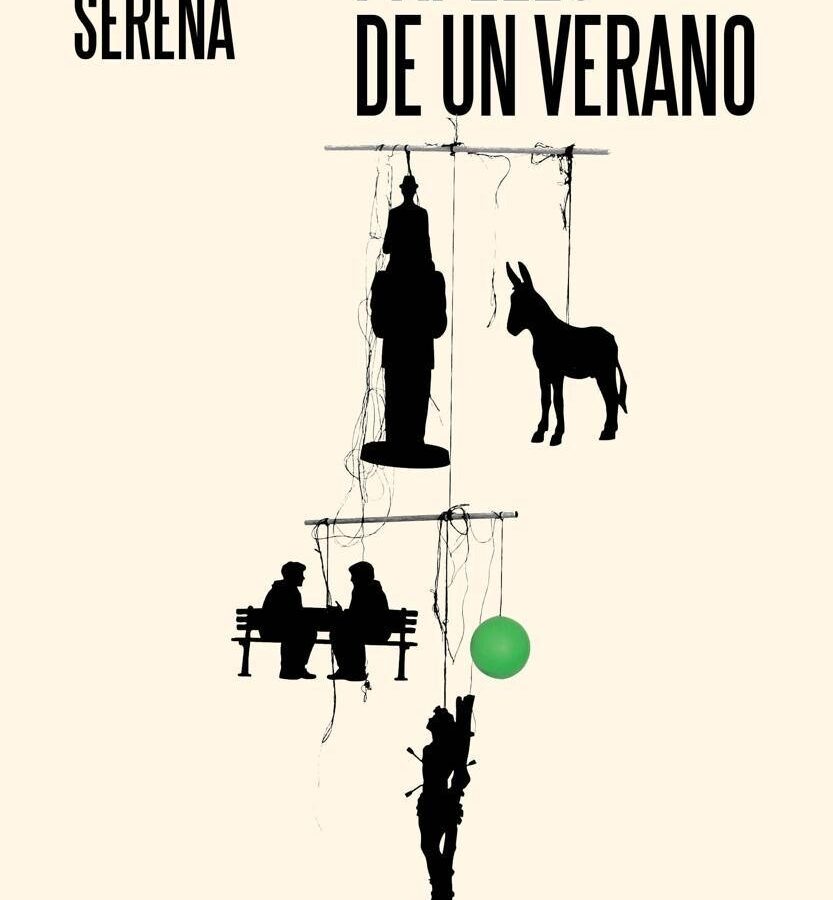
Javier Serena (Pamplona, 1982) releases his fourth novel, Summer Papers, whose narrative time centers on the months of July and August 2006. The protagonist’s given name, his age at the time of the events, and the city of origin of the character, who is now in Madrid, coincide with those of the author. Thus, it seems plausible that he is fictionalizing a biographical episode.
The text opens with a justificatory explanation and a suspense that will endure throughout the work. “Fran expected from friendship things that a friend could not offer, and that Prague morning in Vyšehrad Park gave the first warning of the misunderstanding that affected us all and would lead to the delirium of his accident.” What will happen to Fran? What signs precede the final event? How did his friends react to them and, above all, the protagonist and narrator, Javier?
The novel is sustained, to a large extent, by the progressive and sometimes staggered narration of Fran’s actions, which reveal his personality and his anxiety. The essential witness of that conduct, the narrating character, struggles between paying attention and caring for his friend on one side and his own problems on the other, which prevent him from properly attending to the one who suffers alongside him, as he himself notes on more than one occasion.
Javier has traveled to Prague to begin his incipient vocation as a novelist, which is his most desired personal project; however, once back in Spain, he cannot overcome a creative block, turning him into the butt of some mockery. He shares a flat with rather strange roommates who are very annoying, making it impossible to establish a cordial relationship. His family is absent: Javier does not dare to return to his hometown and embrace his defeat. His loneliness grows, and his group of closest friends breaks apart, each one pursuing his own path. The two summer months are spent in a job he does not want, in a dark office whose objectives are unclear and that offers little incentive, even to the point of becoming fearsome: “I caught an image that depressed me: the woman relegated to the hallway absorbed by her Tetris game […]. I was so afraid of resembling her, by the contagion of her proximity, that I reacted immediately.” In a time as uncertain as it is emotionally barren, he begins a relationship with a capricious young woman who shamelessly uses him for a kind of erotic games designed to provoke a voyeur who watches her: “for her, my visits allowed her to flirt with some risks in which she attempted to find some summer fun.” A young woman who cancels dates abruptly and always has something better to do so as not to see him.
Javier Serena offers us a panorama of the bewilderment and the hardness of twenty-four, a time when the period of formation has passed and the decisions do not end up being satisfactory; of his friends and of himself, he says: “we did not have an easy fit with reality”; these are lives that wrestle with “loneliness or abandonment” and suffer “shrinking of sadness,” given the precarious emotional, occupational and vital uncertainty at that “first frontier of life.”
In that shared context, Fran, a visual artist who has tragically lost his love, slides down a slope of pain that alerts Javier and Federico, who try to help him. Yet, where one would expect sincere conversations among them in which hidden feelings and the ultimate causes of that suffering are revealed, and where initiatives to confront it would be taken, we instead find delays, lack of commitment, and miscommunication. “He came to Madrid […] only to spend a few days with those who then were his closest confidants. // On this occasion, he insisted on sleeping at my house, and I could not offer myself an excuse again”; “but his voice proved so intimidating that an immediate sense of suffocation overwhelmed me, and I remained mute”; “neither Federico nor I knew what to say in response to the warning, and his threat [to commit suicide] hovered in the air for a few seconds, the time it took one of us to sidestep the awkwardness of the silence while commenting on the furniture.” In short, a failure to intervene in his friend’s problem, since there is only one priority: “my difficulty in conforming to any other path than my own.”
Lola López Mondéjar, psychoanalyst and writer, author of a pair of excellent essays: Invulnerables e invertebrados: Mutaciones antropológicas del sujeto contemporáneo (2022) and Sin relato: Atrofia de la capacidad narrativa y crisis de la subjetividad (2024, Anagrama Essay Prize), attests to a generation of young people she treats in her practice, where vital disorientation, the inability to narrate one’s own story, coldness in relationships, use of others for personal satisfaction, fear of commitment, difficulties in communication, and the absence of an inner life are visible. A smart device used by Javier Serena in his novel to show the real distance that still exists among those closest is the substitution of dialogues with mere direct phrases that the interlocutor never collects. I believe much of the interest of this work, with its very refined language and careful construction, lies in its eloquent capacity to represent this human landscape, so real, woven from indifference, barely disguised selfishness, fatigue, disorientation, fears, frustrated intentions, and cool passions.
—————————————
Author: Javier Serena. Title: Summer Papers. Publisher: Almadía. Availability: All of his books.