
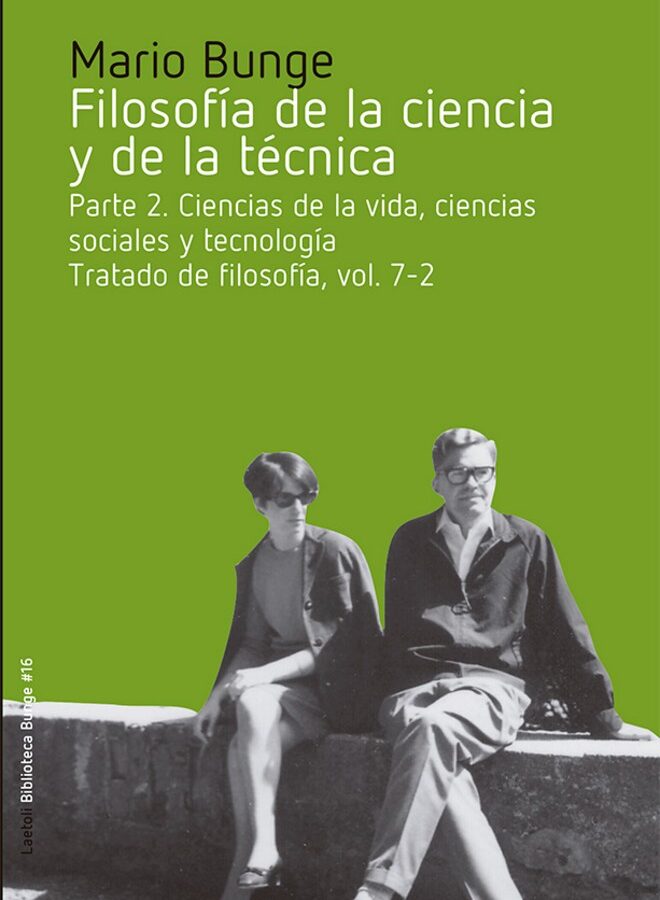
Here lies a systematic framework for analyzing scientific and technological knowledge, as well as the relationship between science, mind, language, and technology. In this book, Bunge clearly anticipated the complexity of transdisciplinarity, and the social and ethical dimensions of science and technology today.
In this making of Antoni Hernández-Fernández, editor and translator of this edition, reflects on Philosophy of Science and Technology. Part 2. Life Sciences, Social Sciences, and Technology. Treatise of Philosophy. Volume 7.2., by the physicist and philosopher Mario Bunge (Laetoli).
***
In the era of Artificial Intelligence (AI) and Large Language Models (LLMs), discussing the translation process implies assuming that the bulk of the workload has shifted, to a large extent, toward technical revision. At the twilight of the crude translator, the need for an expert reviser arises. Only a few decades ago translating a work of this kind primarily demanded solving linguistic problems. One needed to find the right term, reproduce the author’s style with precision, maintain terminological coherence, and, in short, avoid the maxim “traduttore, traditore.” Today a LLM can generate in seconds a reasonable, fluent, and seemingly reliable version for a lay reader of virtually any fragment of text. Despite the imminence of traditional problems, the added challenge lies in determining whether what appears well translated is also conceptually correct.
This difference becomes especially important in a work such as Mario Bunge’s Treatise on Philosophy.
It is not a literary text, nor is it easy, but it allows for a certain freedom of interpretation in the translation process. One grapples with philosophical and scientific terminology (and though few, with some formulas and technical schemes), when language shapes and transduces a mental architecture.
Thought reflected in words. And the concepts here are not merely interchangeable lexical units in the text: they occupy a specific place within Bunge’s philosophical system.
Thus, one must understand each argument first, to then verify that the linguistic solution adopted works in Spanish. This is no trivial matter, and given the broad scope of the present volume, the key has been human allies beyond the machines. Fortunately, in the revision process I have shared the journey with Alfons Barceló, a distinguished pupil of Mario Bunge, as well as with Serafín Senosiain, editor of the Bunge Library at Laetoli.
Because, paradoxically, the appearance of AI does not eliminate the task of revision, but makes it more visible, indeed crucial. Revision has gained weight in all sectors, and it will continue doing so. It is already paid (and will be paid) much less for tasks automated by AI, but it should be paid much more to those capable of detecting its ever-diminishing errors. Take it to medicine: if an AI-based oncological detection system had, say, a precision and reliability of 99.99%, how much should we pay the physician who detects that 0.01% error in cancer detection?
Returning to the book’s universe, a language model may offer a formally flawless translation and, at the same time, introduce minor terminological deviations, or false friends, that alter the meaning of the original. The statistics of LLMs tend to choose etyma that appear seemingly more natural, alter terms the author used with a precise sense in the original language, or remove nuances that, due to their technical nature, should be preserved. The stochastic fluency of the LLM is not a guarantee of quality: the translation may sound perfectly Spanish and yet be conceptually erroneous. Thus, the edition of this volume occupies that space between translation, specialized knowledge, and critical revision. In this sense, generative AI is a very useful tool for the translator, but it should not replace their judgment: the more specialized the work, the more important it is to know the subject matter being translated.
However, if LLMs are used, one should reflect on which models are employed: are they open-source and public, or do they belong to greedy companies that parasite our data? Bunge warned us in 1985, in chapter 6 of this work:
“There is therefore no need to fear the mythical runaway technology. If someone feels threatened by a machine, they simply have to disconnect it; and if any technologist attempts to do something other than serve their employers, they merely have to fire them. What we must fear is the owners of the technology, for they are the ones who use it to produce or prevent social changes.”
I proceed to offer, as a preview and another quotation from the book, which I hope you enjoy reading (and studying) as much as I do. As a preview, I can say that we already have underway the translation and revision of the next volume (the eighth and final) of Mario Bunge’s Treatise on Philosophy. It deals with ethics and, as is fitting, although written in the 1980s, Bunge again anticipates much of the social problems that continue to beset us. It will surprise you. In the case of the tech sector, facing the mass arrival of false prophets and newcomers in the AI era, I recommend the technoethical meditations that already appear in this volume 7.2, where Bunge warns us:
“We have become accustomed to accepting a reasonable level of risk because we have experienced the benefits of many technological innovations, and also because we have been taught the belief that the new is always better. The problem lies in the fact that we do not know enough to anticipate such risks, we do not even know how to quantify them, and all the more we ignore the threshold below which it is reasonable to accept any risk.”
And, honestly, beyond the decisive labor impact of the AI surge in translation and editing, I believe we have not yet fully confronted the enormous risks of linguistic and stylistic homogenization from the mass use of language models in the book sector. Because the betrayals of translators, after all, humanized those texts—note that—but now I fear more the subterraneous betrayals of AI, the watermarks on terms that increase their frequency according to an algorithm, and, above all, the feudal lords who govern them, the owners of the technology. Do not forget them. Bunge already warned us. Let us not depend too much on them. After yielding to their particular ius primae noctis in our daily tasks, we will have already lost our dignity. We will have yielded to cognitive drain.
The reflections in Mario Bunge’s Treatise on Philosophy are both an indispensable reference across all fields of knowledge and a balm against the stupidity and superficiality prevailing in the use of new technologies in the 21st century. Do not miss them.
—————————————
Author: Mario Bunge. Title: Philosophy of Science and Technology. Part 2. Life Sciences, Social Sciences and Technology. Treatise of Philosophy. Volume 7.2. Publisher: Laetoli. Availability: All Your Books.