
Although nothing is said about the writer on the back cover or the book’s flaps, Miguel Ángel Ruiz is the author, in addition to this volume, of a novel highly celebrated by readers and critics, titled Almenara, published a couple of years ago: a genuine outpouring of fine prose and evocative lyricism through which this veteran and prestigious journalist from Águilas introduced himself, so brilliantly, in the purely creative arena.
Misses and Jellyfish, whose subtitle —
Why the Mar Menor Went Bad — offers a clear sense of the author’s intentions, is, in a sense, the synthesis of a project pursued, with the steadiness of a Cistercian monk, for decades. And, at the same time, the most effective way for a journalist expert on the matter to denounce, to the four winds, with names and surnames, unflinchingly, the agonizing state of one of those small seas that some unscrupulous people have priced at their own risk and peril.
Although the appearance of technical terms is inevitable—such as “anoxia” or “eutrophication”—this is by no means a book intended solely for ecologists and other specialists. In fact, Miguel Ángel Ruiz cannot help, at times, but inject a subjective note, expressing his sorrow and his perplexity before events that he recounts with such care, apart from the inevitable figures and the resulting statistics that amplify his words. Thus, for example, in the chapter titled, precisely, “Anoxia,” dated October 12, 2019, three years before the so-called “Green Soup” occurred. There, he refers, in detail, to that particular expression of the fish, “which awakens compassion,” with their eyes fixed and their mouths agape: “That last gesture humanizes them (…). Contemplating that chilling image freezes the blood”.
From a structural standpoint, it comprises well-measured sequences, with a date in front that shifts according to the needs of the narrative, with constant jumps in a back-and-forth time, without causing chaos for the reader. The diary begins on May 27, 2016, and ends, with an “Epílogo,” in September 2026, ten years after the appearance of the Green Soup, awaiting what may happen to a dying sea, almost on the brink of extinction, in its last gasps and final breaths, like those fish that once tried to flee a burning sea that no longer had a drop of oxygen left in it.
Miguel Ángel Ruiz possesses data to sustain a more credible, consistent, and truthful argument. Thus, he reaches back to a 1980 study by Garcia Dory, an early advocate of ecology in Spain, who already warned of the risk of irreversible deterioration of the Mar Menor. His advice, however, was never heeded, and the madness of construction and of unfettered, savage agriculture continued with the complicity of nearly everyone, and, above all, of the politicians responsible during those four decades.
The images, in the various media, of those suffocating fish circled the globe. Miguel Ángel Ruiz reminds us, drawing on his seasoned journalism, always at the front line, that neither the frequent cases of political corruption, nor poverty, nor schooling neglect, nor low wages, nor the health care that besets the Region of Murcia ever managed to alarm a citizenry that, at last, could see the wolf’s ears and believe the solid arguments of a few who warned us of the imminent disaster.
The figures cited by the author of these pages, written in clear and elegant prose where form is not neglected despite the decisive importance of the substance, are overwhelming, almost unbelievable. Especially when he speaks of the inhabitants of those waters. One of his most emblematic beings could serve as an example: the seahorse, those hippocampi reduced to just over a thousand individuals today, when four years ago they numbered in the tens of thousands. The deficient oxygenation has facilitated algae growth and the rise of jellyfish populations, which, though harmless, give as much trouble to the weary bathers as they complain about. Not to mention the proliferation of species foreign to the Mar Menor, real guests who had not been invited to this party, such as the blue crab, which has managed to displace the green crab that had long thrived there.
Miguel Ángel Ruiz does not hesitate to point a finger at the principal culprits of this saga that resists ending happily. Thus, as in the famous Celaya poem, he denounces in writing, with data to back it up, the misdeeds of farmers and ranchers, as well as the neglect and complicity of all administrations, fueling the social indignation that is on the rise.
The chapter titled “Misses,” which corresponds to a July 1989 chronology, though perfectly integrated into the whole, is a true masterpiece, despite its brevity and small number of pages. At the Trips disco in La Manga, a competition was held on that date, a somewhat shabby one, under the motto “Miss Wet T-Shirt.” There, young women from countries such as Sweden, England, Germany, and Spain gathered. The jury consisted of actress Mari Paz Pondal and TVE journalist Santiago López Castillo. The winner was a Murcia girl named Sara, who walked away with a handsome prize of one hundred thousand pesetas and a bouquet of flowers.
Meanwhile, as the lively revelry continued and people lost their composure with the drinks, dawn broke over the neighboring Mar Menor, which at the time was a recreational area, a respected natural space, unable to imagine what lay ahead: “The rising sun climbs inch by inch along the façades of the buildings where thousands of people are about to flush the toilet.” The literary intention of the author is clearly perceptible, with that sudden strike in a moment of singular beauty.
In a book that reveals elements characteristic of the purest crime novel, with its dead, its killers, its accomplices, its defenders and its culprits, there could not be missing certain characters that lend more verisimilitude to the narrative. Characters like Selva Carmichael, who seems drawn from a Valle-Inclán farce or from his monumental novel Tirano Banderas; or another, much better known in these parts near the Mar Menor, Tomás Maestre, once the owner and lord of much of La Manga when it was still an unexplored paradise, more akin to a Lampedusa-like work—cultured, with refined manners, a true believer without a doubt, and of a powerful temperament. Carmichael, a Malaysian-born entrepreneur who promised multi-million investments to turn that tongue of sand into a new Marbella, wore a black tuxedo and flaunted “a disheveled hair carefully lacquered, with tips dyed with silver highlights that contrasted with his dark skin.” He was one of those who spend money with a smile and perfect teeth: “Trust me,” he repeated again and again, “with the gaze fixed on his interlocutors”. Not long after, he was imprisoned for fraud and sentenced to three and a half years in a UK jail. Another villain in the shadows, out of circulation.
In the accomplices section, highlight those hair-growth sellers who, by all means—eloquence and cheap proselytism—tried to alter the narrative, attempting to impose what Miguel Ángel Ruiz calls “an alternative truth.” Nothing simpler and more effective than turning the agrarian lobby into the victim.
Could this Mar Menor, at this point, ever recover, a lost cause, the dream of a shadow or the shadow of a dream broken entirely? No one will be able to call the author of these pages a catastrophist or a doomsayer. He adheres to stark truth, no matter how painful it is, and his words throughout this journey through the work reveal a faint hope as if night had not fully fallen. Yet urgent action is required, and those who truly know the subject must be allowed to work.
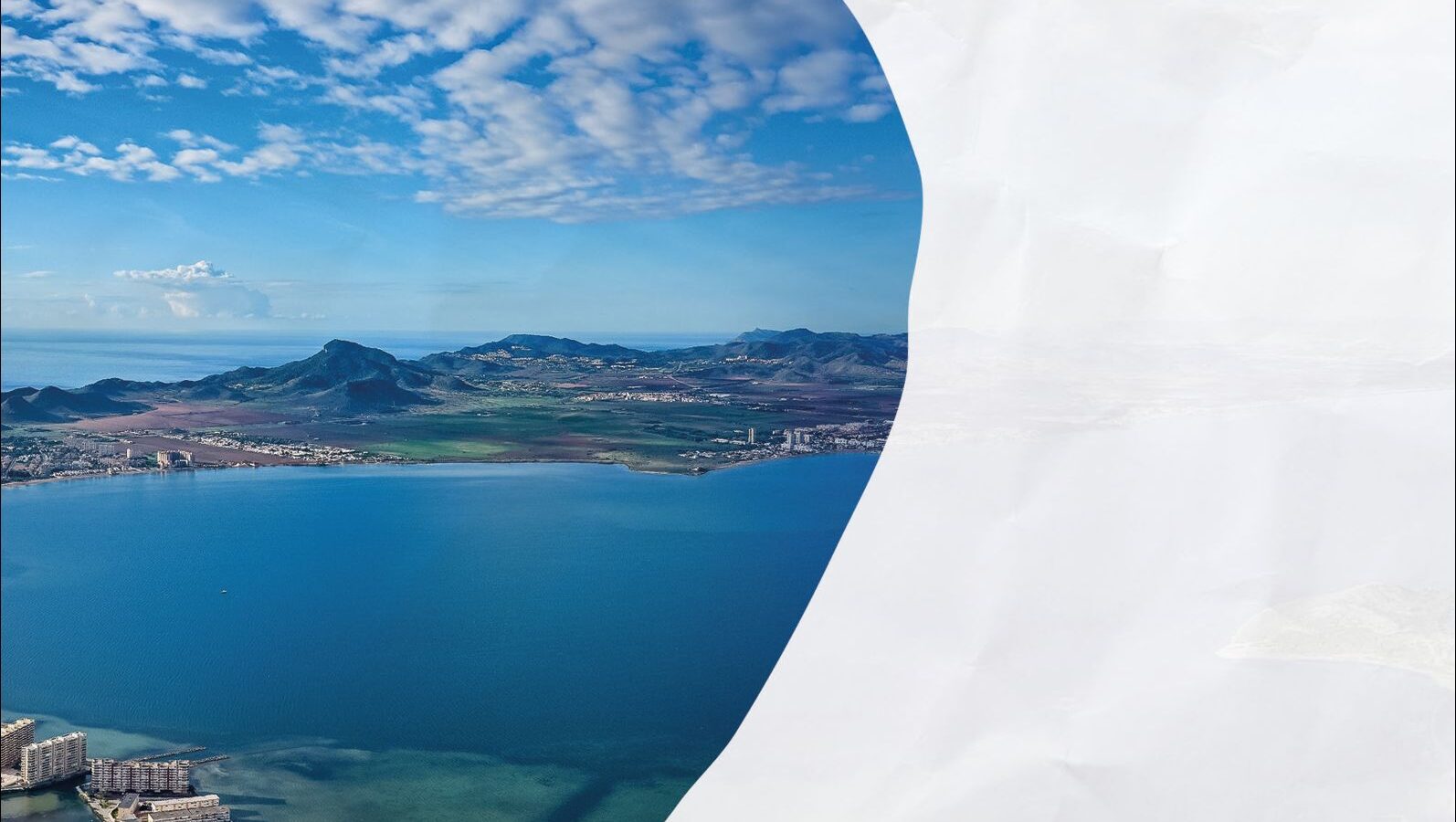
In the opening lines of Conversations in the Cathedral, by Mario Vargas Llosa, one of the most authentic and representative works of the so-called Spanish-American Boom, one of the characters asks: “In what moment had Peru been screwed?” In the splendid and moving book by Miguel Ángel Ruiz there is also more than a mere attempt to pinpoint the moment when the Mar Menor succumbed, that small saltwater lagoon in Spain’s Southeast visited by peoples across the centuries, the Sea of Children, one of the planet’s most beautiful corners that is about to become a new Chernobyl, an awful, eternal, and contaminated green soup.
—————————————
Author: Miguel Ángel Ruiz. Title: Misses and Jellyfish (Why the Mar Menor Went Bad). Publisher: Tundra. For sale: Todos tus libros.